In Harie, Shiga(Japan), water canals run through much of the town, and the people there use it to develop a mutually beneficial relationship with fish.
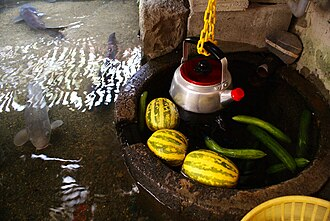
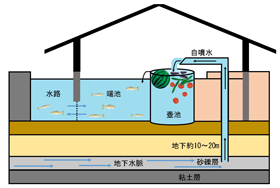
Imagine a pool of water that people use for washing fruits, vegetables, and dishes. That same pool has carp that call it home, and the carp eat the scraps and keep the water crystal clear. This could be inside the home or outside, but it is constantly added to by natural spring water, and the water exits in to a canal. This system is called “Kabata,” and has been used for over 300 years. [1]
The Wider Benefit:
That running water then heads to rice flats, which benefit from the natural fertilizers the fish provide. That water then heads to wetland area, where the water is cleaned by reeds and other vegetation before entering a lake. [2]
Ceramic water filters became particularly popular in the 1800's in London, when poor water qualities were often reported on. [3] Since then, they spread across the world.
They are an inexpensive water filter which uses the small pore size of the ceramics to filter out impurities. You pour water into the top half, and that water slowly filters into the lower half. Since it only needs gravity and does not cost anything to run, it is a very cost-effective way of filtering water.
Some (though not all) also come with a activated carbon filter to aid in the removal of chemical contaminates (like chlorine) and/or a special silver treatment to help kill bacteria, mold, and algae. [1]
Since many people in the world do not have save drinking water or do not trust the water from their local treatment plants, these filters can provide a filtration method that does not contribute to the use of bottled water.
Note: When treating water directly from a wild water source, it is generally suggested to use a filtration method along with a method of disinfecting (such as boiling). This is because while filtering can remove many dangers, it can not remove viruses. [2]
]
Maintenance:
The top half should be cleaned regularly to keep the ceramic pours free of impurities. This can be done with soap and water, or just water and a bristle brush.
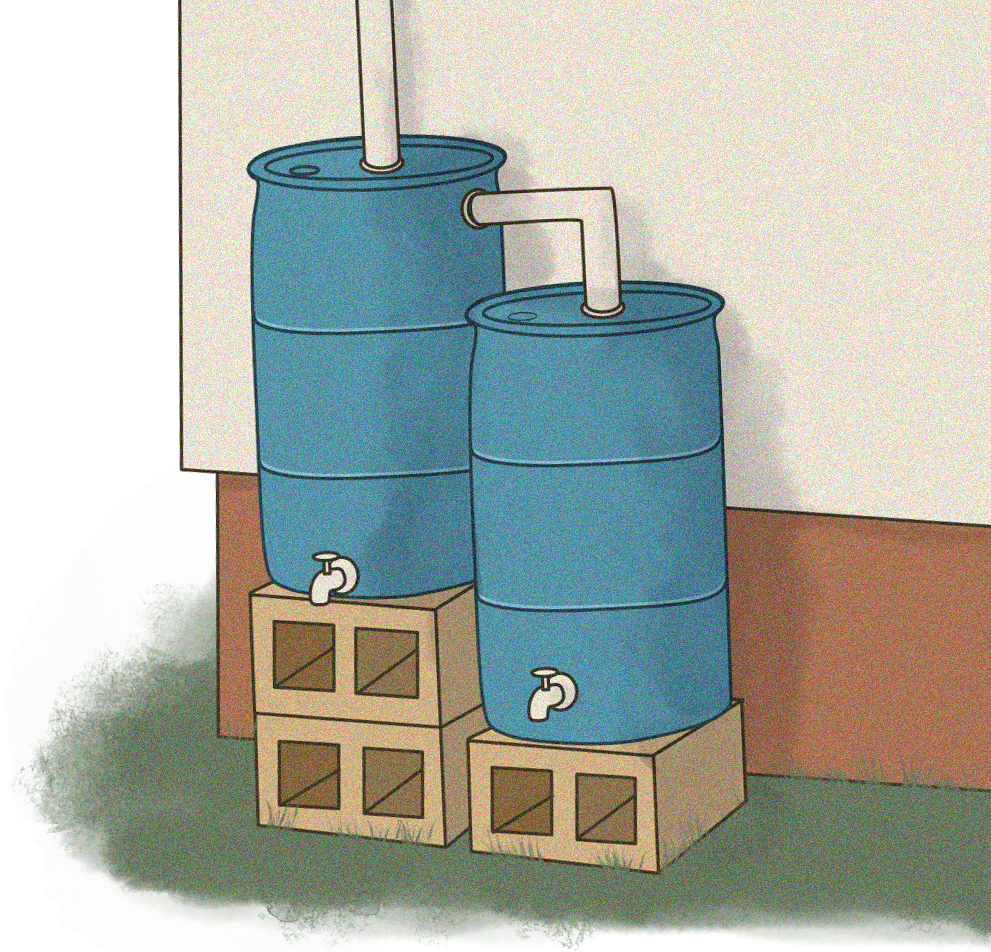
Rain barrels (also called rainwater tanks) collect rainwater runoff from rooftops by using eavestroughs and downspouts to carry and funnel water into the barrel.
Since this is untreated water, it is healthier for the plants in your garden [1] while also saving you money on your water bill.
The use of the barrels can assist drought-prone areas by collecting water in the rainy season which can then be used during the dry season. This reduces the strain on local water reserves.
Before Buying
Many cities do also have incentives to buy rain barrels, so be sure to do some research on that for your area.\
Some places (such as some USA states) have different regulations regarding water capture, so please look into that as well. [2]
Tips:
Barley: If you are having trouble with algae, try barley. It helps restrict algae growth. [3]
Mosquito Dunks: If you have a open-faced (no mesh or cover) barrel, consider a mosquito Dunk to help deal with mosquito larvae in a safe way. [4]
Timers: If you water at the same time every day, consider a battery-operated faucet timer and a soaker hose
Gravity: If you can get your barrels higher than the ground you are planning to water, you should be able to water without problems
DIY Option
Supplies:
Garbage can with a lid
Valve Spigot
Screening
Drill and drill bit
Waterproof duct tape
Instructions:
Use the drill and drill bit to make a hole near the bottom of the container for the valve spigot.
Install the valve spigot (installation instructions will vary depending on what you buy)
Use the drill and large drill bits to make a hole or several holes in the lid.
On the top side of the lid, cut the screening so it will cover the holes, and tape in place with the water proof duct tape.
Place the lid upside down over the container so the rim of the lid helps to funnel the water
Place your new rain barrel under your downspout.
Optional: Add another tap near the top of the container if you want to link multiple containers.

 ]
]