Rant.li

Reader

Read the latest posts from Rant.li.

from BabunobGem

BabunobGem began with a love of needlework and the quiet joy of creating something meaningful by hand. What started as a personal passion for embroidery gradually became a small artisan studio in Vietnam. Today our own small team designs and finishes every piece by hand, from embroidering the flowers to finishing each headband, clip and scrunchie. We work with linen, cotton embroidery thread and yarn, in small batches, so every accessory has its own small variations.

What we make

We also sell our own pieces wholesale and take custom embroidery orders on request.

Contact

Find BabunobGem around the web

#BabunobGem #HandmadeHairAccessories #EmbroideredHairAccessories #FloralHairAccessories #HandmadeInVietnam

 
Read more...

from clarkj21

Registering for an HSK exam without knowing your actual proficiency level often leads to one of two outcomes: paying for a test you cannot pass or sitting through a level that fails to challenge you. Most students try to gauge their readiness by flipping through outdated textbooks or estimating their progress based on how many characters they recognize. This approach is rarely accurate because the HSK tests specific skills in listening, reading, and writing under strict time constraints. Before committing to a registration fee, you need a way to measure your current performance against the specific requirements of the 2026 HSK 3.0 syllabus.

Why self-assessment is difficult

Most learners overestimate their level because they confuse familiarity with mastery. If you have spent months working through a single workbook, you might recognize the patterns within those specific pages, but that does not mean you are prepared for an exam that introduces new vocabulary and complex structures. Language testing requires you to perform under pressure, where fatigue and the clock can turn a familiar passage into a series of unrecognizable sentences. Furthermore, the 2026 HSK 3.0 syllabus has shifted requirements significantly, expanding to 11,000 words across nine levels. Using study materials that are not aligned with these standards creates a false sense of security that disappears the moment you sit for the real exam.

Finding your starting point

To avoid wasting time and money, you should start by taking an objective measure of your language proficiency. A quick way to get a baseline is to use the HSK level test, which provides a snapshot of your ability by using adaptive difficulty across all nine levels.

Find your HSK level in 3 minutes

This test takes about three minutes to complete and requires no account. Note how the questions adapt to your performance, providing a much clearer picture of your range than a simple count of words you think you know. This is a vital first step, as it prevents you from signing up for a level that is too low to prove your skills or too high to be achievable in your current study cycle.

Using the HSK score calculator

Once you have a target level, you need to understand what constitutes a passing score for that specific band. Many students guess at the pass mark, but it is better to use an HSK score calculator to check your progress against official thresholds.

HSK Score Calculator interface

By inputting your estimated marks for listening, reading, and writing, you can see if your current performance meets the requirements for your target. This tool removes the ambiguity of wondering if your writing scores are dragging down your total points. If the calculation shows you are consistently below the threshold, it is a clear indicator that you need to focus on specific sections rather than just repeating general study exercises.

Validating with a full mock test

Knowing your level and target score is helpful, but the ultimate test of readiness is completing a full-length exam under timed conditions. HSKWin provides an independent platform where you can take a 2026 HSK 3.0 Mock Test for any level, from 1 to 9. These mocks mirror the reality of the test room by combining listening, reading, and writing into one session.

Unlike self-grading, which is often lenient, the automated scoring on this platform gives you an immediate report after you hand in your work. You get an explanation for every answer you missed, which is the most effective way to address knowledge gaps. For the writing portion, the AI evaluates your responses based on content, language, and structure. It identifies the specific sentence that caused a deduction, allowing you to see exactly where your grammar or character usage failed. If you struggle with speaking, the platform also offers HSKK practice sets at Beginner, Intermediate, and Advanced levels, providing AI scores and feedback on your recorded responses.

HSKK practice options

The platform includes a mistake book that stores your errors until you mark them as learned, ensuring you do not repeat the same mistakes. You can start with a free full-length mock to get a baseline before deciding if a paid plan is right for your ongoing preparation. This approach is superior to generic practice because it forces you to face the full breadth of the exam syllabus.

Can I take the mock test without paying?

Yes, every account includes the first full mock test for free without needing a credit card. You can use this to gauge your current performance and determine if your chosen level is realistic.

How does the writing evaluation work?

Writing is evaluated by AI against the official dimensions of content, language, and structure. The system ties deductions to the specific sentence where the error occurred, giving you direct feedback on how to improve your writing.

Is this the official exam board?

No, this is an independent website and not affiliated with the official HSK or Chinese Testing International. It is designed to help you prepare for the 2026 syllabus through mock tests and practice tools.

Do I need an account to practice listening?

Listening practice does not require an account, though you will need one to benefit from full-length mock exams and the mistake book feature. You can start with the free tools to evaluate your needs before signing up for a deeper study plan.

Set aside time to complete a full mock test this weekend, and use the results to build your study plan for the next month.

 
Read more...

from nevynosynij

Why is it important to examine this question? — It exposes flawed approaches to defining sin, flawed ways of discerning good and evil, which in turn distracts and disperses attention from what is essential: the struggle against real sins and the consistency (rationality) of reasoning. The latter concerns calling things by their proper names; Christians are called to straightforwardness in their judgments (Matt. 5:37): if a pyramid before us is black, we say it is black; if it is white, we say it is white. If something before us is a sin, we consistently avoid it as evil; if it is not a sin, we accept it as a good (acceptable) thing.

How Self-Gratification Became a Sin

Inattentive biblical scholars of antiquity extrapolated the sin of Onan — an Old Testament figure who interrupted the act of intercourse — onto any ejaculation without the purpose of procreation. Medieval moralists upheld this determinism: they pushed masturbation beyond the margins of the acceptable, and unprofessional physicians echoed them, claiming that the act was harmful to health, led to blindness and madness, caused hair to grow on one’s palms... Such radical alarmism from the “WHO” of the day, fueled by influencers and mere loudmouths, sowed a veritable panic throughout Victorian society! Boys (children) had it hardest: in addition to verbal sermonizing and the whip, “restraint devices” were “manufactured” for them — often of an overtly sadistic character: with spikes, clamps that plucked out pubic hair, metal cock-cages, bells; and some anti-masturbation activists even proposed performing surgery — implanting a silver wire into the foreskin in such a way that it would cause acute pain during an erection. Special bland diets were devised for children, as it was believed that fatty, spiced food was “arousing.”

The spread of anti-masturbation sentiment in Europe and the USA was driven by weak or absent critical thinking: a few publications under sensational headlines from authorities or even anonymous writers sufficed to infect people with collective hysteria. The closedness of communities and the lack of information created a veritable hothouse effect for irrationality — people simply had no way to verify the data and found themselves in an echo chamber. Collective psychosis, the herd effect: real psychological traps into which anyone can fall, regardless of education level or historical era. Most likely, those “inventions” for the prevention of masturbation largely remained on paper as patents, or were displayed as prototypes. Mass production in the modern sense did not yet exist, and custom-made orders cost money that the average European could not afford to squander on some contraptions — and so he confined himself to moralizing and frightening his own children.
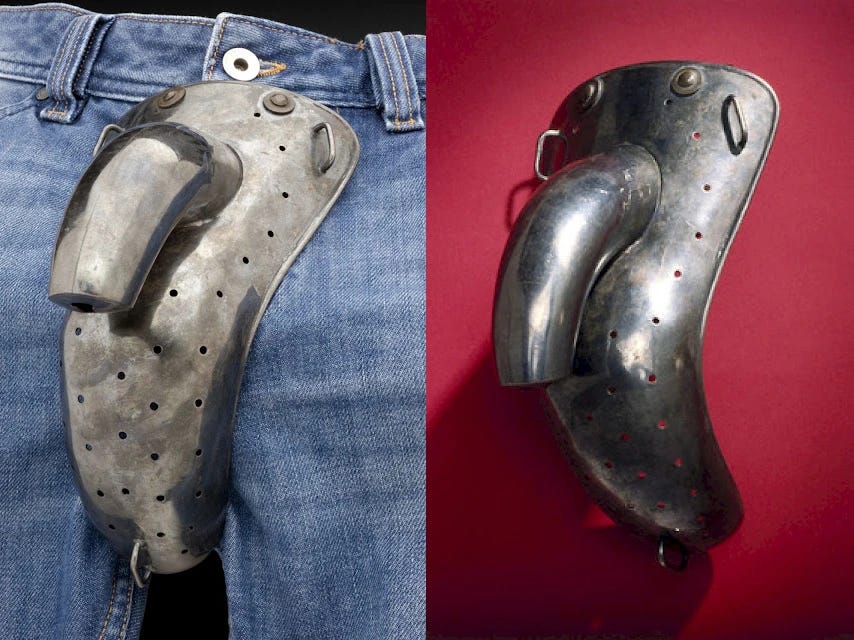
By the designer’s intent, this sadistic instrument is fastened at the groin with four little straps and does not interfere with everyday life, nor does it spoil one’s clothing. Urination is possible without removing the apparatus (or even one’s trousers), after all, anyone who decides to wear such a device should not be bothered by trifles like urine. The wearer of a cock-cage is visible from afar, even when he is not dressed in leggings. The device also helps one push through the crowd at the marketplace; during the storming of a castle, a soldier equipped with a cock-cage marches ahead of the battering ram; in the kitchen, the cock-cage serves well for straining pasta, and it is also handy for cracking nuts. In a word, this thing is useful not only for torture, but in everyday life as well.

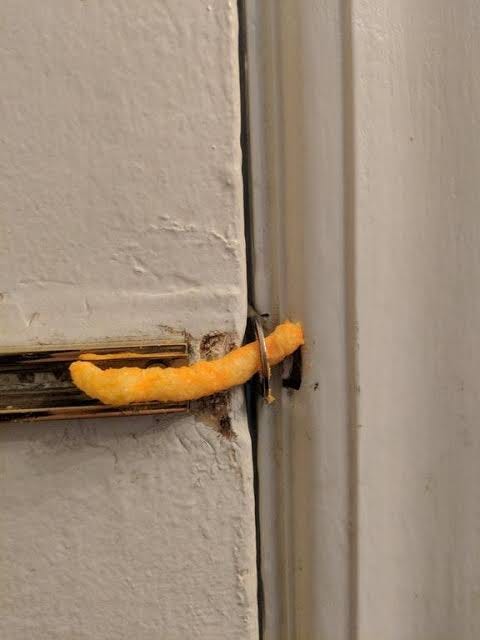
The effectiveness of all those anti-masturbation measures can be easily illustrated with one meme:
What was the attack on masturbation grounded in? Above all, in ignorance. The physicians of that time simply did not know how human body was constructed, and those who resorted to religion for their critique failed to grasp the essence of Christianity — the evangelical spirit: grace, forgiveness, love. Physicians linked masturbation to conditions for which they could not find the true cause. Religious moralists relied on the notion of self-defilement, a product of the Jewish magical consciousness, which missed the main point: God created man in His own image and likeness, and therefore man cannot contain within himself mechanisms of self-defilement — something that defiles him uncontrollably (like nocturnal emissions or sexual desire). What defiles man is licentiousness and adultery; those are sins grounded in sexuality that proceed from his heart — not what he does with his own body. The Apostle Paul says in his First Epistle to the Corinthians: “the body is a temple of the Holy Spirit” (6:19) — and it is well known that temples come in all manner of architecture: some prefer Gothic, some Baroque, some neo-constructivism, some cannot accept minimalism in temple architecture — but none of this affects whether the temple remains a temple of the Holy Spirit regardless of someone’s aesthetic preferences. It is for this very reason, among others, that piercings and tattoos are not a sin.

Interestingly, before the modern era, the English-speaking (Latinized) milieu used the phrase “nocturnal pollution” to denote emissions, where “pollution” derives from the Latin “pollutio” — “defilement” — and it most often appeared with the adjective “nocturnal” (nightly), which betrays an all-around misunderstanding: emissions occur not only at night but during the day as well, and they do not “defile” man. Later this misandric archaism was replaced by “nocturnal emission,” which removed the irrelevant negative connotation (“emission” being the neutral “discharge”) — though it retained the inaccurate “nocturnal.” In the 18th century, on the wave of the medicalization of self-gratification, the term “self-pollution” appeared as a synonym for “masturbation”; thanks to common sense, it never caught on.

The absurdity of the fierce medieval (in the broad sense) sinification of the act can be reduced to the following formula: just as masturbation is a terrible sin, so is deliberate defecation or urination. This is an error in every sense: biblical, biological, and logical.

Ancient (Pagan) Roots of Masturbation-Canceling

If we dig deeper, we run into ancient philosophy — into the Stoics and the Neoplatonists, who held the material world in contempt (e.g., Plotinus), considering it the “bottom of being,” and the body, accordingly: shackles and a burden that must be cast off in order to be set free. The ancient philosophers believed that the soul (human person) is a slave of the body, that the body enslaves the soul through the passions in particular; accordingly, the body and the material were identified with evil. Later, many of these ideas migrated into the Christian worldview of major denominations and crystallized into their asceticism as a foundation. The expediency of such borrowing from pagan thought is questionable. What is the fundamental error of those philosophers? Not knowing God, they did not know of His infinite mercy and love, of the fact that He is good and is the Creator of the Universe; and so they mixed good with evil, called God’s creation — the Universe — evil, and called the “garments” (physical bodies) that God made for humanity in Eden evil as well. Plotinus calls inanimate matter “ugly” in his treatise “On Beauty” and in the same place says: “So, we may justly say, a Soul becomes ugly — by something foisted upon it, by sinking itself into the alien, by a fall, a descent into body, into Matter” — that is, the soul, upon entering the body (matter), is thereby, as it were, defiled by it, becomes “loathsome.” This is nonsense, since “soulless” matter: mountains, the ocean, valleys, the starry sky, the cosmos itself — is unquestionably a manifestation of beauty and goodness. Genesis 1:31 sums up God’s work on the Universe: “And God saw every thing that he had made, and, behold, it was very good.” Likewise, human body is nothing vile, nothing that can defile the soul; person defiles himself with evil — with evil deeds and evil thoughts (Matt. 15:19-20) — while the body serves him only as an instrument. Is the hammer to blame when you strike your own finger with it? Physical allurements can cause pain through passions, but only when man (the soul) lacks self-control and caution in handling the “hammer.” Matter is incapable of defiling the soul for yet another reason: the material universe cannot contain the immaterial soul in principal. The soul, having descended into the material, becomes, as it were, a witness to the material, yet not a part of it — still less such a part as is utterly absorbed by the material. Plotinus groundlessly calls the physical dimension the “bottom of being” — groundlessly, for it is impossible to judge the world objectively without stepping beyond its boundaries. The true “bottom of being” is alienation from God, a conscious turning away from goodness, a plunge into evil, into sin; such alienation is a plunge into slavery, is self-shackling — that is truly hideous! If being has a “bottom” at all, it is hell, not our world. Finally, a simple logical inference about the dimensionality of our world refutes Plotinus with his “bottom of being”: we live in a three-dimensional reality; it is logical to suppose the existence of two- and one-dimensional realities, which would then have to be located below Plotinus’s “bottom.”

Those ancients saw the body as a prison, whereas the Apostle Paul calls the body a temple; the ancients desired to “undress,” to free themselves from the body, but Paul says: “For we who are in this tabernacle [the body] to groan, being burdened, not for that we would be unclothed, but clothed upon, that mortality may be swallowed up by life” (2 Cor. 5:4). Do you catch the radical divergence? We understand the body as beautiful garments (body aesthetics occupies a vast sphere within art and sport) made for us by God, which, however, are beaten, like moth-eaten fabric, by our imperfection, our sinfulness, and our departure from God; and we want to get rid of sinfulness, not the body, of those shackles through which we hate ourselves (John 12:25); we are drowning in helplessness, and yet we hope in the Son, the Deliverer (John 8:34-36). Jesus did not get rid of His physical body after the resurrection. Recall the episode when He entered the room where His disciples had gathered, and Thomas was among them, who could not believe that Jesus had risen but wanted to verify everything with his own eyes; then Jesus showed him His hands and the nail prints (John 20:25–27). Jesus convinces the disciples that they are not seeing a spirit: “Behold My hands and My feet, that it is I Myself. Handle Me and see, for a spirit does not have flesh and bones as you see I have” (Luke 24:39). Indeed, Paul says the very same thing regarding the body of a Christian when he expresses the desire to be “swallowed up by life,” to be under the sway of the life of Jesus, rather than decay and death.

Another nuance: pre-historic philosophers considered sensory pleasures “low” and animalistic, but feelings belong to the soul, not the body. Qualia are an experience of the soul; the body merely transmits information, while it is the soul that perceives and interprets it, and the soul itself feels pleasure or displeasure, not the body. Therefore, by calling sensuality “low,” they attributed the “low” to the properties of the soul, which is unacceptable since the soul — man — was created in the image and likeness of God. In general, the concept of “low” sensations contradicts, once again, the logic of those wiseacres: they attribute sensations to the corporeal, as if matter (evil and vile according to their own notions) could give birth to something pleasant, such as the taste of good food or an orgasm. But how is that possible when matter is bad? Does a bad tree bear good fruit? (Matt. 7:17).

Thus, pleasant sensations are rather a “sample” from above — you know those perfume samples in a store? — such a sample is given to man, to the soul, from high realities to distinguish pleasure from displeasure. We can preserve this sample for God’s sake, meaning we can practice asceticism, or we can also use it for God’s sake with gratitude to God every time we “spray” that sample: “He who observes the day, observes it to the Lord; and he who does not observe the day, to the Lord he does not observe it. He who eats, eats to the Lord, for he gives God thanks; and he who does not eat, to the Lord he does not eat, and gives God thanks” (Rom. 14:6).

One cannot judge person for his preferences; everyone evaluates their being in their own way, everyone walks to God by their own path (on the narrow way (Matt. 7:14)), and such a path is mostly individual, it is your path to God, and if you decide that some pleasure in life is “low” or sinful, this conclusion is relevant exclusively to you — you believe in it, and you will receive according to your faith.

Take a panoramic look at those primordial speculations; read at least the foundations of Plotinus’s teaching on Wikipedia: it is an absolutely mechanistic ideology, utterly devoid of feeling — there is no heart in it! With a stone face, the author speaks of the soul’s desire to be divorced from the material and united with the immaterial, to return to a transcendent homeland — but you do not believe this author; it seems he does not himself believe what he says. His words sound like the clatter from the entrails of a robot; there is nothing human in those words — they are alien to man, alien to one who has a heart. That is why ancient wisdom is incompatible with Christianity, with a religion that has a heart. The luminaries of ancient philosophy called philosophers and sages those who battled against their own body as against sin; yet the struggle against one’s own body is not a struggle against sin! The material is incapable of sinning. In Christianity, a wise man may be called one who masters his body, subordinates it to his will, skillfully governs it — and this professional does not despise his body, just as an artist does not despise his brush, a carpenter does not despise his chisel; on the contrary, he cares for his body so that it may be able to carry out its principal task: God’s commandments. Jesus commanded cutting off that part of the body which leads one into sin (Matt. 5:29-30); the ancient ratiocinators command cutting off everything indiscriminately — whether it leads into sin or not, simply cut off everything, mortify the body. Will a dead body be capable of praising God? “Wilt thou shew wonders to the dead? shall the dead arise and praise thee? Selah.” (Ps. 88:10). If so — by all means, cut off everything; if not, keep what will help you praise God in word and in deed. When a Christian cuts off a part of his body that impels him to sin, the Christian understands that the body is not at fault — the temptation is, the allure, the motion of the heart: the soul’s intention. This commandment demands unconditional decisiveness in the struggle against sin and hatred of oneself (John 12:25): whoever pities himself will not be able to overcome the fear of suffering or death, and sinfulness takes advantage of this. Self-sacrifice for the sake of lofty goals — love (John 15:13), the Kingdom of Heaven (Luke 9:62), faithfulness to Christ (Rev. 20:4) — is not identical to a struggle against one’s own body; in Christianity, the body helps achieve those goals, for like that grain of wheat (John 12:24), it is sacrificed unto the fruits of eternal life, and herein is revealed the true value of the material: it imparts to the spirit the potential to blossom into a tree bearing good fruit; the suppression of this potential or its improper application diminishes or wholly deprives it of fruit. Matter contains no sin within itself — a stone cannot be sinful, and neither can the body. If you are inflamed at the sight of a stone, the cause of the inflaming lies not in the stone, not in the body, but in your heart, in your soul.

Sin is always begotten by a heart that is weak toward good, by a soul with flabby muscles of the will — and only afterward is that sin realized through the imagination or through a physical act, carried out by means of the physical body.

Thus, to consider the body sinful, or capable of its own accord of causing the soul to sin, is a fundamental conflation of cause and effect. It is also necessary to understand that the flesh demands nothing bad: bodily thirst needs water, bodily hunger — food, bodily fatigue — sleep; sexuality, too, manifests itself through need and has its own paths of satisfaction. Recall Mark 14:38: “Watch ye and pray, lest ye enter into temptation. The spirit truly is ready, but the flesh is weak!” — and explain to me, how can a “weak flesh” overcome a ready (strong) spirit? Evidently, it battles with itself; and so one must not shift the blame for sin onto the body — that is the same as blaming the bullet for the killing.

As can be seen, the problematic of the sinification of self-gratification has a broad perspective and reaches down into ontological questions, where, having passed through subjectivization, it becomes an aspect of the animality — or, through objectivization, becomes an aspect of sexuality, a manifestation of the synergy of the soul’s and the body’s constitution.

What Was Onan’s Problem?

In ancient Judea, the Jews had a strange law of levirate marriage, under which a younger brother was obliged to beget a child with the wife of his elder brother if the latter had died without leaving offspring. Even if the younger brother was already married, he had to lie with a woman who was not his wife... Onan was such a “younger brother”: his father sent him to Tamar, the wife of the deceased Er. Onan agreed to fulfill the law, but practiced coitus interruptus, for he did not want to give Tamar a heir. It was precisely this — the interrupted act of intercourse — that someone took for masturbation... The error is entirely obvious and requires no comment: onanism is not the same as masturbation.

Masturbation is not mentioned in the Bible at all — neither in the Old nor the New Testament.

The story of Onan is told in Genesis chapter 38; let us try to uncover the issues it raises. To do so, one must know the historical context. Childless widows in ancient Judea held a highly precarious socio-economic position: without an heir, they could not inherit their husband’s property (it reverted to the husband’s family) and lost the possibility of merely feeding themselves (women, with certain exceptions, did not work); moreover, a widow had no right to remarry until the rule of levirate (yibbum) or the ritual of halizah (refusal) had been performed. When, for whatever reason, yibbum or halizah was not carried out, the woman remained in the status of an “eternal widow” and had to return to her father’s house — but there she might not be taken back, in which case she was condemned to a life of beggary.

In those times a barren woman faced social shaming: barrenness was considered a great disgrace and a punishment for sins. This is an important point for understanding the consequences of Onan’s failure to fulfill the levirate: Tamar would have been considered barren.

And although Judah’s family (Tamar’s husband) provided Tamar with everything necessary, without an heir her future looked uncertain. It is therefore hard to believe that Onan was failing to fulfill the levirate with Tamar’s consent — all the more so since later, after Onan’s death, Tamar tricked Judah into lying with her. And if there was no such consent from Onan’s side, then his behavior constitutes a form of violence — sexual exploitation.

It was for this — the mistreatment and exploitation of a widow — that Onan was, most likely, punished with death, and not for “masturbation.”

What Masturbation Actually Is

It is the satisfaction of a sexual (biological) need. The functioning of the body’s mechanisms in human is subordinate to precise rules, interference with which can lead to suffering or death. For example, a human being needs food and feels hunger when deprived of food; this is a vital rule — if one disregards hunger and does not eat, the body perishes. The same holds true of thirst and sleep. Sexual desire, too, is “built into” the body’s mechanisms; these desires arise neither by suggestion nor through sinfulness — they arise of themselves and are absolutely natural; nevertheless, a human has the capacity to control them, and if necessary to ignore them.

Sexuality, though not categorically among the vital needs of the organism, is nonetheless part of human biology and of human soul. Sexuality is connected with love; it is a manifestation of eros, which itself derives from agape — this proves that sexuality belongs among the properties of the soul.

Mechanically, masturbation is no different from eating, sleeping, or drinking; accordingly, if masturbation is a sin, then the mechanical and deliberate satisfaction of other biological needs is a sin as well. One must also take into account its autoreflexivity — that is, this process concerns no one except the one performing it, and such processes, as we have already established with the “body as temple” example, are, on the whole, non-sinful.

Nor can this process be called objectively obscene — no more than defecation or flatulence. Subjectively, self-gratification can be aesthetic or unaesthetic, which bears on shame; for the most part, however, the aesthetics of masturbation are determined by age and grooming: and an elderly man, or a man with an ungroomed body, engaged in this occupation will look less aesthetic than a young, well-groomed one.

In the wild, self-gratification is widespread among at least 400 animal species — among apes, dolphins, horses, and bats in particular — which likewise underscores the naturalness of the process. There is no point in drawing parallels here with infanticide, cannibalism, or other manifestations of radical behavior in the animal kingdom, since our topic lies outside the category of violence and bears a private character. Anyone who claims that masturbation is an act of animal behavior commits a crude error, for by the same logic eating and drinking would also be animal (shameful) behavior — since animals, like humans, eat, drink, breathe, sleep, and have sex. The common features of animals and humans are not shameful; they are the result of sharing life within the paradigm of an organic body. That is why, for example, the design of the organic body of man has many elements similar to the design of the organic body of an animal: two eyes, two ears, one mouth, one nose, four limbs, and so on. What truly constitutes shameful animalistic behavior is the display of aggression, violence, and killing.

Modern medicine refutes Victorian amateurism and emphasizes the benefits of masturbation: in particular, frequent ejaculations (8+ per month) help maintain (2, 3, 4) prostate health, which, according to studies, is associated with a decrease of prostate cancer risk of approximately by 9-20 % in relative terms, the release of hormones relieves stress, improves sleep, and produces euphoria.

A Bit of Polemics on Harm: Real and Conjured

Some counselors recommend entering into marriage in order to avoid the “sin” of masturbation — which is entirely inappropriate, if only for the reason that person’s first attempts at self-gratification occur before puberty, in infancy. Of course, these attempts are devoid of sexual context and are performed rather in the process of exploring one’s own body, for the sake of obtaining pleasant sensations and relaxation; they are performed reflexively — but technically, this is masturbation.

As John Paul II aptly noted in his 1994 “Letter to Families”: “The person can never be considered a means to an end; above all never a means of “pleasure” — that is, one must not use a human being for the attainment of one’s own goals, especially when it comes to “pleasure.” Such a utilitarian attitude toward a person is overt egoism, disrespect, or even exploitation — and it was for sexual exploitation, evidently, that Onan was punished! So the advice to “marry against masturbation” is simply harmful — it distances person from love, for the edifice of the marriage vow must be built on love, not on the desire to satisfy biological needs. A marriage “against masturbation” is a marriage of convenience — the same as those contracted, for instance, for money.

To argue the harmfulness of self-gratification by the acquisition of a psychological or physical addiction is futile and illogical, because everything — any activity whatsoever — is capable of inducing some form of addiction; and besides: in an addiction, the subject is at fault, not the consequence (masturbation), but the lack of self-control (the cause). Immoderation in food leads to obesity; lack of restraint in gambling, to ludopathy; carelessness with alcoholic beverages, to alcoholism; people become addicted to smartphones, video games, the internet. In themselves, alcohol, gadgets, food, and games are good fruits, and addiction does not make them cease to be good; what is bad is the addiction itself — the excess in use and consumption.

Imagination and Pornography

Some may agree that purely mechanically masturbation is not a sin, but that the sinfulness lies in sexual fantasy or in watching pornography; such a position is half-true. Here it is important to distinguish between an action that arouses desire and an action that does not arouse desire.

“But I say unto you, That whosoever looketh on a woman to lust after her hath committed adultery with her already in his heart” (Matt. 5:28). Although this concerns adultery (marital unfaithfulness), it nevertheless reveals the principle of Christian ethics in overt (objective) and covert (subjective) acts. Conduct in objective reality must correspond to conduct in subjective reality — for one can “look” upon an object of desire with the eyes of the body as well as with the eyes of the soul (in the imagination). This principled stance lies in the straightforwardness, the sincerity of the Christian, who does not bend his soul, who is harmless as a dove (Matt. 10:16). When you pledge a vow to your beloved — to share your very being — you must hold to that vow not only in actual reality but in imagined reality as well, in your fantasies. Would we call a Christian sincere who repeats aloud the commandment “Thou shalt not kill,” while in his dreams pronounces death sentences?.. And what if those dreams are reinforced by a desire for revenge, a desire for violence (the urge to inflict pain)? The imagination is a creative field for “painting,” but desires arise in the heart, in the wellspring of feelings; the begetting of sinful desires by the heart is a serious cause to reflect on the purity of one’s wellspring. As we know: one and the same spring cannot send forth both sweet water and bitter (Jas. 3:11). So when the spring produces bitter water, it is an obstacle to the creation of sweet water, to the creation of good. The imagination is fully subordinate to the mind, and the mind often leans upon the feelings; therefore do not think that everything “painted” in the imagination is a priori innocent. The imagining of sinful scenes and actions, when it is grounded in sinful desire, testifies that the bitter water has overflowed the bounds of the sensory basin onto the field of the rational; such a course of events must be accompanied by a loud alarm signal.

With adultery all is clear — but what if a man has no partner? Even in that case, to place real people in one’s sexual fantasies is a presumption — impermissible within the bounds of culture and high self-awareness. Never mind that it is impossible to imagine something real precisely, since you cannot copy a real image into your imagination, only its reflection; to trifle with the imagination means to trifle with one’s own upbringing. On the whole, however, sexual fantasy (within the bounds of ethics), like the watching of (legal) pornography, is not a sin. An adequate sexual fantasy depicts a natural act; the same is done by pornography in which all the participants act with consent and publish the material for the general public.

Note carefully: the phenomenon of commercial pornography itself — people having sex for money with various partners — is a form of prostitution (fornication), that is, the selling of one’s body for money, and this is not normal. Non-commercial pornography (without changing partner) can at most be called shamelessness. Becoming a witness of something abnormal is not a sin: no sin comes from watching a horror film or an action movie depicting killing or torture; nor is it a sin to watch real footage of military operations, a recording from an FPV drone camera. One must, however, keep watch over oneself, so that such videos do not evoke a pleasant feedback in the soul. A video from the battlefield, for instance, ought to evoke disgust and revulsion in the soul — the same goes for horror films; there is a difference, though: horror films are a product of artistry, of fiction, while war footage is real, and this exerts far greater pressure upon the mind; depending on the constitution of one’s soul, this pressure is capable of breaking through the psyche’s protective mechanisms and inflicting psychological trauma. The same holds true of realistic pornography — especially of the illegal or unaesthetic kind: such videos are capable of traumatizing the psyche. Realism in pornography is therefore better avoided; preference should be given to animated genres — and better still, to abstain from explicit content altogether.

A second important note: if we define commercial pornography (with real actors) as a form of prostitution, then paying for such content makes one part of the clientele of that service. Paying for solo content — on some “OnlyFans,” say — is a lesser fault, since this genre is free of the sin of fornication (intercourse with various partners); yet this sponsorship is all the same, at the very least, financial complicity — and at the very most, a form of (visual) prostitution: the buyer purchases (virtually) another person’s body for sexual gratification, or (if he is not himself a consumer of such content) sponsors (encourages) that activity. The distinction between the nuances lies in the presence of desire for intimacy with the person who has been paid money to display nudity: if the imagination is goaded by such desire and paints a scene of a sexual nature with that person, this is rather visual prostitution; but if that person serves merely as a trigger of arousal, while desire and imagination stand apart from the person — then it is financial complicity.

The problem with funding commercial pornography (with real actors) lies in the absence of fiction: even when it is a fictional product (the events unfold according to a script), the people on the screen are performing a real act — and this is the principled distinction between a pornographic film (fictional) and a feature film: in the latter, everything is fiction. This rule is general and admits of no exceptions. Compare the purchase of fictional content — a war film, for example — with the purchase of the real thing, when someone donates to FPV drones and then watches on YouTube a clip in which “his” drones tear people apart: the former is familiarization with the topic; the latter is complicity in it. The same with pornography: either you pay for real content (whether framed fictionally or not) and become a financial accomplice of a real act, or you pay for full fiction content (animation (no real act)) and just support the author’s creativity.

Advertising on pornosites cannot be called a form of funding pornography, since the advertising is displayed without the viewer’s consent, and besides, no one forbids the use of an ad blocker.

Let us now examine the main theses of the critique (the sinification) of pornography (in generalized form).

  • Sometimes the voyeuristic character of pornography consumption is pointed to, but this is incorrect, since “voyeurism” means, above all, “peeping”; the viewer of pornography, however, is not peeping at the events, for all the participants in them are aware of what is taking place. And what of the feature film in which the director shows a scene (intimate or not) through a keyhole? Such an effect can indeed make the viewer feel like a voyeur.
  • We have already spoken of addictions, and yet I have not heard of anyone watching porno for 6-8 hours a day, but that is precisely the “average screen time” today for social media, TikTok, YouTube; algorithmic feeds drag people into dopaminergic traps, immerse consciousness into a kind of trance, into doomscrolling. In this state a man loses count of time, drops out of reality, however, no one is in a hurry to criminalize social media? “Active” watching of pornography has a “biological safety catch”: the refractory period. What safety catch do social media have?
  • To speak of the instrumentalization (exploitation) of person (in porno), of the loss of subjecthood by the characters on the screen, of the absence of empathy toward them — today, in an age of technological development, when visual content is created by AI, or by the efforts of animators, artistsand 3D modelers — is hyperbole and anachronism. What harm is done by objectness (superficiality) in the watching of hentai, when all the participants are fictional? Consider, too, that pornography can be part of a feature film, a documentary, architecture, or sculpture. Or “that’s different”? :)
  • Simulacra and hyperstimulation in animated porno can indeed lead one astray, but this is nothing exclusive to pornography: just look at Instagram with its perfect bodies, luxurious living, and total success?! Or at the AI art, which is for the most part idealizations of images.

Ultimatelly, there is no necessity for pornography when one has imagination. In some cases the use of pornography is justified by aphantasia or by the need for a dopamine boost (with long abstinence, day-long dopamine dips with psychosomatic effects are sometimes possible; short sessions of (so as not to provoke daytime emissions) “passive” porn viewing (starting with the lightest (static), such as adult manga) may help restore the dopamine balance and ease the condition), but even then there are countless genres of pornography besides the realistic one (with real actors); and therefore the notion of pornography as a genre of “exploitational” cinema that devalues human person and relationships is a generalization that falls outside the focus of objective critique.

Why Self-Restriction Is Needed, and for Whom

Truth be told, why these challenges (the NNN type), these acts of self-restriction outside asceticism? The answer is simple: self-knowledge and the training of the muscles of the will; the possession of self-control allows one to become that athlete who has perfect mastery of his body and knows how to walk the tightrope.

Asceticism should not be considered something proper exclusively to the monastic way of life: in Christianity, everyone ought to practice self-control, since Jesus Himself fasted forty days in the wilderness (Matt. 4:2), and more than once commanded His disciples to fast (Matt. 6:16-18; Matt. 9:15; Matt. 17:21); Luke in 2:37 emphasizes fasting as a form of service to God. The cutting off of one’s own bodily parts (Matt. 5:29), or making oneself a eunuch (Matt. 19:12), can likewise be understood as a form of fasting.

Returning to the “perfume sample,” let us uncover the motivation for keeping and using it. The meaning of sacrificing the temporal lies in this: to have the capacity, the hope, of receiving the eternal. However, it cannot be said that the one who sacrifices the temporal will infallibly receive the eternal, and that the one who does not sacrifice the temporal will not receive it. No, the opportunity to receive the eternal belongs equally to the one who sacrifices everything and to the one who sacrifices nothing. Do you remember Matt. 19:25-26? — on his own, person cannot pull himself up by the hair out of the quicksand; only God can pull person out of a mire, and therefore it is important to understand the personal character of one’s relationship with God, a relationship in which there is no place for justification by the deeds of others. Christians are not those workers who peer into the palm of their neighbor receiving his pay from the master of the vineyard (Matt. 20:12-16); you cannot say: why did he receive the eternal without sacrificing the temporal? If you see value for yourself in sacrificing something temporary, that is your choice; whether or not to make such a sacrifice is a personal decision, but it is God who decides what each person will receive in return for these sacrifices.

A prohibition in upbringing, or self-upbringing, is effective only from the standpoint of ratio: a right prohibition of masturbation must rest exclusively on asceticism; in all other cases self-control is to be applied, as a safeguard against addiction. How does one recognize an addiction in oneself? Try abstaining from self-gratification for one month a year, by joining the NNN challenge, for instance. If no problems arise with this, you are free of addiction. If it does not succeed, try to limit the number of masturbations to 1 per week for a month, next year in the same month let there be 3 restricted weeks, and 1 completely without masturbation, then 2-2, finally 1-3, and for the 5th year there should be fully dry month. And if even such gradualness proves too difficult, then your self-control is in need of leveling up. In what follows, after weighing the risks (for instance, those concerning the prostate and dopamine), this step can become a foothold in “drying out” the month opposite November — May, and further, according to one’s own plan of ascetic exercises.

A Straight Reply to Critics

Should someone reproach me with “temptation” (Matt. 18:6), I will answer: temptation is life in a lie. One must not hide the light of truth with the thought of “good intentions” — such a thought rests on the irrational, on sand, and on it no sturdy edifice of Christian life can be built. To brand masturbation a sin while understanding its non-sinfulness, for the “safeguarding (salvation) of people” through self-restraint, is deception; accordingly, to teach abstinence from masturbation as from a sin is to teach a lie and a self-deception — and there is no salvation in deception. Christians must go about with their lamps lit (Matt. 25:1), must preach the truth from the housetops (Matt. 10:27), not hide away out of uncertainty, shame, or fear. Having gone up onto the roof and declared: “Masturbation is a sin!..” — you must finish the phrase either thus: “...For me,” or thus: “...Because...” Without rational grounding, any speech is mere rhetoric. A speech that does not rest upon truth (the objective) is rhetoric. The medievals once tried to argue the sinfulness of self-gratification from the housetops, and they arrived at the absurdity of metal cock-cages, because that argumentation was devoid of truth.

I am tempting no one into sin, since, firstly, the topic of this article — masturbation, is not a sin; secondly, the de-sinification of self-gratification is not equal to an encouragement of it. What am I doing? I am saying: “Masturbation is not a sin, but one must not trifle with it, for this occupation is closely connected with combustible things, such as dangerous (harmful) pornography (visual prostitution), unethical fantasy, psychological addiction, and unwanted unaestheticness.” And if something is not sinful, this does not yet mean that one must necessarily make use of it: “All things are lawful for me, but all things are not expedient: all things are lawful for me, but all things edify not” (1 Cor. 10:23). Everyone decides for himself what to make use of, and how.

This article does not incite masturbation; the purpose of the article is to dispel a lie. The article can become the start of conscious work upon oneself, and not only on the speculative plane, for here real advice on self-control is given, useful both to beginners and to experienced practitioners of abstinence.

If the reader who had been abstaining subsequently abandons his practice, it means he was not truly abstaining at all, he was seeking an occasion to look back (Luke 9:62); whereas the reader who had not been abstaining, and subsequently takes it up, will most likely achieve results, since his abstinence will rest upon a full awareness of what he is doing, how he is doing it, and for what purpose. This very thing — a full awareness of the article’s topic — is one of the chief aims of the article.

Recall the episode in Matthew 15:1-20, when Jesus dismantled the Pharisaic myths about defilement: the Pharisees held to the rules of kashrut, for they believed that having eaten an “unclean” animal man is infallibly defiled; the same, by their conviction, happens in the case of eating with unwashed hands or from unwashed vessels. Jesus rejected all of this, saying: “Not that which goeth into the mouth defileth man: but that which cometh out of the mouth, this defileth a man.” At these words the Pharisees were tempted; Jesus, having learned of it, said: “Every plant, which my heavenly Father hath not planted, shall be rooted up. Let them alone: they be blind leaders of the blind. And if the blind lead the blind, both shall fall into the ditch...” It is not a problem of the truth that someone misunderstands its context.

Asceticism

The de-sinification of masturbation is beneficial for ascetic exercises. First of all, the realization of the normality and sinlessness of self-gratification frees the ascetic from pride or arrogance, preventing him from viewing those around him — people outside the skete (whether external or internal (spiritual)) — as sinners or intemperate. In terms of ascetic practice itself, nothing changes for the ascetic: he continues to abstain from self-gratification, but not as from a sin, rather as something offered as a sacrifice for God’s sake, by analogy with a temporary or perpetual fast, when certain foods, drinks, or entertainments are surrendered as a sacrifice.

Such a rethinking allows the ascetic to look at his labor and relationship with God from a new angle, revealing greater sincerity and rationality: previously you abstained from masturbation as from a sin and did not do anything special (after all, everyone is supposed to abstain from sin), but now you are sacrificing something valuable. In this context, abstinence should be even easier, since a sacrifice given to God cannot essentially be taken back, whereas one can repent of a sin over and over again, which not only devalues the act of repentance, but in some cases drives a Christian into a vicious circle of endless repentance for a single sin and, ultimately, self-deception. This happens due to placing an unbearable burden upon one’s shoulders (Lk. 11:46), or due to choosing the wrong methods of self-control.

Conclusion

Objectively, self-gratification is not a sin, and it never was. One cannot live in a lie, nor is there any benefit in saddling oneself with fabricated sins. The principles of “the worse, the better” and “a lie for salvation” are errors. Worse is simply worse, and a lie remains a lie — a sin — regardless of the context.

______________

This article is translated from Ukrainian by AI (Vibe, Gemini).

 
Read more...

from articleseochecker

PUSSY888 and the Importance of Responsible Online Gaming

Online gaming has become a familiar part of the digital entertainment landscape. With improvements in internet access, mobile technology, and interactive websites, people can now explore different entertainment services through computers, smartphones, and tablets. Platforms such as PUSSY888, Pussy 888, and พุซซี่888 are names that may appear in discussions about online gaming and digital entertainment.

While technology makes online activities easier to access, responsible participation remains essential. Understanding the potential risks, protecting personal information, managing time, and making informed decisions can help people maintain a healthier relationship with digital entertainment. This is particularly important when an online platform involves gambling, where financial losses are possible and outcomes cannot be guaranteed.

Understanding Responsible Online Gaming Responsible online gaming means approaching digital entertainment with awareness and personal control. It involves understanding the nature of an activity, recognizing its possible consequences, and establishing boundaries before participating.

People researching PUSSY888 should understand that online gambling is different from ordinary entertainment activities because it can involve financial risk. No platform, game, or strategy can guarantee a positive outcome.

Responsible participation begins with realistic expectations. Gambling should never be considered a reliable source of income, a financial investment, or a solution to money-related problems. Choosing not to participate is always a valid option.

Setting Clear Financial Boundaries Financial management is one of the most important aspects of responsible gambling. Before considering any gambling-related service associated with Pussy 888, adults should think carefully about their financial circumstances.

Money intended for rent, groceries, bills, education, savings, and other essential responsibilities should never be used for gambling. Borrowing money or using credit to continue playing can create additional financial difficulties.

Setting a strict personal spending limit can help prevent decisions from becoming impulsive. Equally important is accepting that losses may happen. Attempting to recover lost money by continuing to gamble can increase financial pressure.

A sensible approach is to avoid participating whenever the potential cost could affect personal stability.

Managing Time Spent Online Digital entertainment is available through internet-connected devices, which makes it easy to spend longer periods browsing than originally intended.

When exploring พุซซี่888 or similar platforms, users should consider how online activities fit into their everyday schedules. Work, education, family responsibilities, sleep, and physical activity should always receive appropriate attention.

Taking regular breaks can help people maintain perspective. Setting a specific time boundary before accessing an entertainment website may also reduce the likelihood of spending excessive time online.

If online gaming begins interfering with daily responsibilities, stepping away is an important decision.

Understanding the Risks of Gambling Gambling outcomes are uncertain. Previous results cannot reliably predict future outcomes, and no method can eliminate the possibility of losing money.

Promotional messages associated with PUSSY888 or other gambling-related websites should therefore be evaluated carefully. Claims suggesting guaranteed winnings, effortless income, or risk-free participation should not be treated as established facts.

Understanding probability and uncertainty can help people develop more realistic expectations. It is also important to remember that gambling services are designed as entertainment activities rather than dependable financial opportunities.

Protecting Personal Information Responsible online behavior includes protecting account details and personal information. Digital platforms may request information during registration or account management, so users should understand how their data may be collected and used.

Anyone researching Pussy 888 should review the available privacy policy and verify that they are visiting the authentic website before submitting personal details.

Strong passwords, secure internet connections, and careful handling of verification codes are useful security practices. Users should also avoid sharing login credentials with people claiming to provide customer support through unofficial channels.

If a website's identity or privacy conditions are unclear, visitors should avoid providing sensitive information.

Recognizing Unhealthy Gaming Habits Sometimes gambling can move beyond occasional entertainment and become difficult to control. Recognizing warning signs early can help people take appropriate action.

Possible warning signs include:

Spending more money than originally planned. Hiding gambling activity from friends or family. Feeling anxious or frustrated when unable to participate. Repeatedly attempting to recover previous losses. Neglecting work, education, relationships, or everyday responsibilities. Anyone experiencing these difficulties should consider stopping gambling activity and seeking professional guidance. Gambling-support organizations can provide confidential information and practical assistance.

The Importance of Age Restrictions and Legal Awareness Online gambling laws differ between countries and regions. A service that operates in one location may not be legally available in another.

People interested in PUSSY888, Pussy 888, or พุซซี่888 should check the applicable laws before accessing gambling-related services. Legal age requirements must also be respected. Gambling is not appropriate for minors, and age restrictions should never be bypassed.

Users should also investigate whether a platform provides clear information about its operating identity and relevant regulatory status. A professional-looking website alone does not establish legal authorization.

Using Responsible Gaming Tools Some gambling services provide tools intended to help users manage their activity. Depending on the platform, these may include spending limits, time reminders, temporary account breaks, or self-exclusion options.

Where available, such tools can support personal boundaries. However, they cannot remove the financial risks associated with gambling or replace individual responsibility.

People should seek additional support if they find it difficult to maintain their limits.

Final Thoughts PUSSY888, Pussy 888, and พุซซี่888 can be considered within the wider discussion of online gaming and digital entertainment. However, responsible participation should always remain more important than convenience or excitement.

Understanding financial risks, setting time limits, protecting personal information, recognizing unhealthy habits, and following local laws are essential parts of informed decision-making. Online entertainment should never compromise financial security, personal relationships, or everyday well-being.

 
Read more...

from Social Media Book Report

Finished “Crisis on Centaurus” by Brad Ferguson.

Cover art of the Star Trek novel "Crisis on Centaurus" by Brad Ferguson. Kirk is pictured on the right, and Spock on the left. In the center is Joanna McCoy wearing a green shirt with something on it I can't quite make out; possibly the top of a tree. In the background is a structure of some kind engulfed in flame. The tag line reads "Enterprise to the Rescue! Kirk must save both a planet and McCoy's Daughter!"

The story opens at New Athens Spaceport on the Federation colony of Centaurus in the Alpha Centauri system. We get an image of a busy travel hub with somewhat anachronistic product placement, which immediately brings to mind the famous 'soup' debacle. My copy is First Edition, but it was printed in Canada, so if someone with access to an American printing wants to check if they see blatant mentions of brand names like American Express or Coca-Cola, or if that was something that got added by a sneaky printer. Memory Beta mentions them, so I suppose it's in the original manuscript. There are a few oblique references like this lightly peppered throughout. Sears Robuck gets a shoutout later in the book too. Which is a corporation that no longer exists IRL. But this is about as intrusive as they get.

Remember traveler's cheques? If you're on the Gen X side of the Xennial spectrum like me, you might remember them as things your parents might use on vacation, or that you'd see commercials for, but that few if any of us ever had a chance to actually use before electronic payment became a thing. This is relevant because the story begins with a Telarite getting angry at an American Express ATM that took his card when he tried to buy some traveler's cheques, and wouldn't give it back. If American Express paid for this product placement, the joke is on them with the banter that follows the destruction of the machine.

The police investigating this disturbance notice a man sitting nearby with a box. The first cop questions him, and is about to move on when his partner recognizes him as a local hate monger, wanted criminal, and all around piece of shit Isidore Holtzman. As they're about to bring him into custody, whatever Holtzman is carrying in the box blows up. The spaceport and much of the city are destroyed.

Meanwhile, on Enterprise, all hell is breaking loose. A critical computer failure causes multiple systems to go offline, including artificial gravity. They manage to get back into normal working order and are planning to set out for Starbase 7 for repairs, when they receive the news of Centaurus, and are diverted to render aid. There's still no official word on casualties, as the disaster is still unfolding, but there are several on the crew with families on Centaurus, some who might have been at New Athans at the time of the explosion, including Bones' daughter, Joanna McCoy, who was a medical student at New Athens. Her fate is still unknown.

There's a flashback, where we get a glimpse of Kirk and McCoy's first meeting 12 years prior, when then-lieutenant Kirk is injured in combat aboard the Farragut, and McCoy oversees his rehabilitation. Near the end of his medical leave, they take a trip together to Centaurus, and meet McCoy's family, including Joanna, who was a child back then. Kirk makes a claim to a spot of land outside of New Athens.

Back from the flashback, Enterprise arrives at Centaurus, and finds they're unable to approach the planet because the planet's defense system is indiscriminately targeting every ship that approaches, and is believed responsible for the destruction of hospital and relief ships that were due to arrive ahead of Enterprise. Enterprise tanks a nuke, and manages to contact the acting president.

Transporters are offline, as the Enterprise is still crippled by computer failure. And the system is flooded by tachyon radiation from the explosion, so they wouldn't be a good idea anyway. So Kirk, Sulu, and their party take Galileo to meet up with the planetary government, while Spock, Chekov, and their party take Copernicus to the planetary defense center to see if they can shut down the missile defense system.

Uhura takes command for the first time, if you don't count novels that hadn't been written yet. And the novel makes a point to call this out. She's arguably had the conn several times. You could say it's her first time in command during a crisis, but she commanded the ship during the battle of Starbase 12 in the “Errand of Fury” series, and single-handedly commanded from Auxiliary Control during “A Choice of Catastrophes”, both of which were set before this. And while she did take command in an episode of TAS, that event was set in-universe after the novel, which was printed later. So this is the first time Uhura took command in print after already but not yet taking command a year from now. Yes, I'm trying to deliberately mangle that to be funny. But this is probably the first time she would have taken command chronologically at time of printing. Unless I'm forgetting any. So it's not incorrect.

It's revealed that a fringe political movement called the League for a Pure Humanity is responsible for the explosion. This group wants to expel all non-human aliens from Centaurus. You know; racists. And they're not just your garden variety “speciest against fictional aliens as allegory” racists. They're actual white supremacists. They'll tolerate non-white humans to a point, if it suits their short-term purpose. But much like racists in real life, if you think you can trust them because they're not currently targeting you, you're a rube. If you're a member of a historically targeted demographic that they seem to momentarily tolerate while they target someone else, they would eventually turn on you too if they get the chance. Real pieces of shit.

The main tension of the novel is a jurisdiction issue between Centaurus and the Federation. The leader of the “League”, Isidore Holtzman, and many other high-leadership figures died in the explosion. But the remaining LPH leadership figures are still in the wind. Terrorist murder is a capital offense on Centaurus, and the acting Minister of Security Nathaniel Burke wants them to face Centaurian justice, and possibly the death penalty. But because an antimatter device was used in a terrorist attack, the Federation has jurisdiction. And Kirk is under orders to apprehend them and bring them back to Earth for trial. Federation civilian court has no death penalty, so if convicted in a Federation court, they'll be sentenced to a cushy rehab colony. So the race is on between Kirk and the local Centaurian authorities to apprehend them first.

Meanwhile, Spock's party manages to shut down the defense system so that ships can approach the system again, and sets out in search of survivors. They find a makeshift settlement of survivors, and begin the process of supplying aid.

For a novel about a disaster response, I figured there'd be a bit more urgency in responding to disaster. Kirk's party spends a night at a hotel in McIverson, another town some distance away. Sulu even manages to spend a night on the town, and the nightlife is described as a town going about their lives as though the capital city of their colony wasn't rendered a smoking crater less than a week ago. Spock and Chekov's party, after shutting down the defense system, spend a night camping out before setting out the next day on a search for survivors. The local government is so inept that the author feels it necessary to address in the epilogue.

The book was released in 1986, well before 9/11. But 9/11 is probably one of the more prominent events that many of us in the west, particularly in the US or Canada could relate to, and more likely to draw comparison. And as someone who remembers 9/11, many of us were in shock for well over a week, and the effort on the ground was around the clock. A novel like this has to hit different after 2001 than it would have before. So that kindof lead me to feel that the tone of the novel was a bit off. Though granted, for my generation and younger, it often feels like we've been living a prolonged series of disasters ever since. Many of them inflicted upon us by our own governments and their corporate overlords. So in that sense; well played, novel. Well played.

My guess is the author felt that other plot lines were more interesting than a prolonged disaster response sequence. And narratively, it was a good choice, and the novel is better for it. But it makes that aspect conspicuous by its absence.

There are a more than few vestigial remains of a different novel that was planned, but then decidedly changed in the process. And I don't disagree. Some of those threads probably weren't going to go where they wanted them to, and had to be tied off.

When we last saw Joanna McCoy chronologically in-universe, it was in the Star Trek Legacies novel “Best Defense”. Another novel that hadn't been written yet. There, she is a smart, and capable medical student who keeps getting taken hostage, but doesn't fold into the damsel role easily. She's an active participant in the plot. If you want to get to know her better, I'd suggest that novel over this one. In this one, she's a little busy, providing medical assistance to the wounded at the recovery center. If she were a real person, who could blame her? But she's not a real person. She's a fictional character who we're supposed to care about, and not just vicariously though McCoy. Who also doesn't heavily feature in ⅔ of the novel. She's still smart. Still capable. Just… you know… kinda busy. So we get Kirk and McCoy's relief on finding her alive, but not much more than that.

Plot points that do get explored are still engaging. I could nitpick them to death, if I wanted to dwell on it, but I've been procrastinating this entry enough as it is. There's the theme of justice versus revenge; Should the surviving LPH members be executed by the state for the murder of millions? Or is it right that they be sentenced to a soft life on a Federation penal colony, even if it's a life sentence? Is the death sentence justice, or just revenge? It's a tension that doesn't get answered easily, and is ultimately left up to the reader. And I suppose that's the right choice. There's not supposed to be an easy answer; just a scenario to consider.

#StarTrek

 
Read more...

from articleseochecker

Building Better Password Habits for Secure Olxtoto Login

Online account security begins with simple habits that protect personal information from unauthorized access. Passwords are often the first line of defense between private account details and people who may attempt to access them without permission. For individuals researching Olxtoto, understanding password safety is particularly important when encountering terms such as olxtoto link, Olxtoto login, Olxtoto daftar, and Olxtoto link alternatif.

A strong password alone cannot guarantee complete protection, but combining it with careful browsing and responsible account management can reduce common security risks. Developing consistent password habits also makes it easier to manage multiple online accounts without relying on predictable or repeated credentials.

Why Password Security Matters Many online accounts contain information that users would prefer to keep private. Weak passwords can make accounts easier to compromise, especially when the same credentials are reused across several websites.

When someone searches for an olxtoto login page, it is important to remember that not every website using the same name is necessarily connected to the same operator. An unfamiliar page may imitate a familiar design to encourage visitors to enter their account details.

This is why password security and website verification should work together. Even a complicated password can be exposed if it is entered into a fraudulent login form. Before signing in, visitors should carefully examine the website address and make sure they understand who operates the service.

Create Strong and Unique Passwords A good password should be difficult for another person to guess. Common choices such as birthdays, personal names, simple number sequences, or familiar words are generally poor options because they may be easy to predict.

Longer passwords or passphrases can provide better protection. A passphrase combines several unrelated words into a memorable sequence. Adding a mixture of uppercase letters, lowercase letters, numbers, and symbols can also improve complexity when supported by the website.

Most importantly, every account should have its own password. Reusing one password for multiple services creates a significant risk. If one website experiences a data breach, attackers may attempt to use the exposed credentials on other platforms.

Anyone researching Olxtoto or using other online services should avoid sharing the same password across unrelated accounts.

Protect Your Olxtoto Login Details An olxtoto login process, like any other online sign-in experience, should be approached carefully. Users should never enter credentials simply because a page displays a familiar logo or platform name.

Check the complete domain before signing in. Look for spelling differences, unexpected additional words, unfamiliar domain extensions, and unusual redirects. A page that looks professional is not automatically legitimate.

Never share passwords through private messages, email, or social media conversations. Legitimate support representatives should not need to know your full password to assist with an account issue. Verification codes should also remain private because sharing them can allow another person to complete an authentication process.

If a website offers additional account protection, such as multifactor authentication, consider enabling it. This adds another verification step beyond the password and can provide extra protection.

Understand Password Safety During Registration The olxtoto daftar process may involve creating an account and choosing login credentials. During registration, users should consider how their information will be stored and protected.

Before completing any form, review the website's privacy policy and terms. Check whether the operator explains its approach to account security, personal information, and data retention. Be cautious if a registration page requests unnecessary personal details or sensitive documents without a clear reason.

Avoid creating an account on an unfamiliar website simply because it promises quick access or special benefits. First investigate the website's identity and determine whether its policies are clear and understandable.

A responsible registration decision starts with knowing what information is being requested and why it is needed.

Be Careful When Using an Olxtoto Link Alternatif Visitors sometimes search for an olxtoto link alternatif when a familiar address is unavailable. However, alternative addresses can create additional security concerns because misleading websites may imitate established names.

Never assume that an alternative domain is genuine just because it uses familiar branding. Examine the complete address and seek independent confirmation of the website's identity before entering account information.

HTTPS encryption is useful because it protects information while it travels between a browser and a website. However, it does not prove that a website is operated by a legitimate organization. Fraudulent pages can also use encrypted connections.

If an unfamiliar page requests an existing password, payment information, or verification code unexpectedly, leave the page rather than taking unnecessary risks.

Use Password Managers and Regular Security Checks Remembering a different strong password for every account can be difficult. A reputable password manager can help generate, store, and organize unique credentials. Choose a trusted application, protect it with a strong master password, and enable additional security features when available.

It is also useful to review account activity periodically. Look for unfamiliar sign-ins, unexpected password-reset notifications, or changes you did not make. If you suspect that a password has been exposed, change it immediately on the affected account and anywhere else it was reused.

Keep your browser, operating system, and security software updated. These updates can help protect devices against known vulnerabilities.

Conclusion Building better password habits is an essential part of responsible online account management. Whether researching Olxtoto, checking an Olxtoto link, using Olxtoto login information, completing Olxtoto daftar, or investigating an Olxtoto link alternatif, visitors should prioritize strong passwords and careful website verification.

Unique credentials, private verification codes, reputable password managers, and awareness of suspicious pages can reduce common security risks. By making these practices part of everyday browsing, users can take a more informed approach to protecting their online accounts and personal information.

 
Read more...

from Mittaldentalclinic

Restore Your Smile with Quality Dental Bridge Care in Jaipur

A healthy, complete smile can make everyday activities such as eating and speaking feel more comfortable. When one or more teeth are missing, a dental bridge may be a suitable option for restoring the appearance and function of your smile. If you are exploring bridge dental services in Jaipur, Mittal Dental Clinic offers professional guidance to help you understand your treatment choices.bridge dental services jaipur

A dental bridge is a fixed restoration designed to fill the space left by a missing tooth or teeth. It typically uses the neighbouring teeth or dental implants for support, depending on the patient's oral condition and the treatment plan. By closing the gap, a bridge can help improve chewing, support clearer speech, and prevent nearby teeth from shifting into the empty space.

At Mittal Dental Clinic, the process begins with a dental examination and discussion of your concerns. The dentist evaluates your gums, remaining teeth, bite, and overall oral health before recommending an appropriate solution. Patients are guided through the available bridge options, expected treatment stages, and care instructions so they can make an informed decision.

Choosing the right dental bridge depends on several factors, including the location of the missing tooth, the condition of supporting teeth, and your personal needs. Maintaining good oral hygiene is important after treatment. Regular brushing, cleaning around the bridge, and routine dental visits help protect the restoration and surrounding gums.

If you are looking for reliable dental bridge services in Jaipur, visit Mittal Dental Clinic for an assessment and personalised advice. The clinic aims to make each step clear, from understanding the treatment to maintaining your restored smile. Book a consultation to discuss whether a dental bridge is suitable for you and take a confident step towards better oral function and a complete-looking smile with guidance suited to your dental health.

FOR MORE info: bridge street dental service jaipur

 
Read more...

from Sikhami Study Notes

“Sir, where's the receipt?” Every coaching owner knows this moment.

This is a short story about a coaching owner buried in registers who can't find a parent's fee receipt. His daughter sets up the institute on Sikhami's Learning studio: batches, timetable, attendance, fees and the team. Next time a parent asks, he has an answer: “Print it, or send a PDF?”

With Sikhami's Learning studio, institutes get:

  • Batches and a weekly timetable
  • Attendance: present, late, absent
  • Fee plans and receipts to print or save as PDF
  • Your team: teachers, accountant, admin

A complete LMS, in one app.

Create your institute on Sikhami: https://sikhami.com/for-institutes (free, also on Android).

#SikhamiStories #Sikhami #CoachingInstitute #TuitionCentre #LMS #Institutes #India

 
Read more...

from jack888888

I help on Friday evenings in the PA closet of a community hall, the kind of room with flight cases stacked against one wall, a kettle that only works if you jiggle the plug, and a folding table that holds the set list, the spare cables, and whoever's jacket does not fit on the hook. This week the band needed practice parts by Saturday morning. They had already booked the hall for a short Sunday run-through. The drummer wanted to hear the drum line without the guitar sitting on top of it. The bassist wanted the bass figure in the middle number, which he had only half learned. Nobody had time to sit through the whole rehearsal recording just to find their own part.

The file had come from a phone on a chair near the mixer, left running through the last two songs of Friday practice. On the phone speaker, held over the folding table, the room sounded like a band. You could hear the kick, the bass, a guitar line, and someone counting in the chorus. You could also hear the chair scrape, a door, and a conversation that had nothing to do with the arrangement. For people who had been in the room, each part was obvious because they already knew what they had played. For someone learning from the file at a kitchen table, it was one smear.

I have stopped treating “just solo yourself in your head” as a plan. The drummer was going to practice on a pad in a spare room, not in the hall with the rest of the band pointing at the drop. Asking everyone to come back and record each instrument separately was not a plan either. Two of them were already on early shifts. The hall was booked to someone else on Saturday. Setting up a proper session in a closet that also stores the Christmas lights was a fantasy for a Friday with the caretaker waiting to lock up.

I needed versions of that Friday take in which the drums, the bass, the guitar, and the vocal could be heard on their own, clearly enough that each person could follow their line and the holes around it without guessing which sound was theirs. I did not need a finished mix, and I did not need to pretend the phone on the chair had been a studio. I needed practice stems I could label with the song title and the part, keep beside the original file, and send without rewriting how the rehearsal had actually sounded.

I did the work on the same battered laptop we use for the set list. I did not install a desktop editor, and I did not ask the committee for a plugin license we do not have. I took only the Friday rehearsal take. The same folder also held a photo of the stage plot and a voice memo about who was bringing the extension reel, and those were not my job. I separated the file into parts, listened through once with the set list in front of me, and checked that the drum stem still had the fill before the last chorus and not a ghost of the guitar sitting in the same place. The original file went into a dated folder with the email and a copy of the set list. I do not replace the take I was given. A later question about a cue, or a reprint of the practice packet, may still want the room as it actually sounded on Friday.

Getting quieter parts did not make the arrangement honest. One entry in the second song was late. One bass note in the middle eight was not the note written on the photocopied chart. Those went back to the band as specific marks, not a vague request for a better recording. A practice stem will not become accurate because the chair scrape has been lifted out. It becomes accurate when the line a person learns is the line the band will actually play on Sunday, including the places that still need a mark.

I started writing a short line on the packet: which file had been separated, which song and part it covered, and which spots had been flagged. A filename like “friday-band” is how you send the guitarist the drum stem between Friday night and a Sunday call time. The copy that goes to each player is named for the song and the part. I also played each stem once through the small speaker we keep for checking walk-in music, not only through the laptop earbuds, because a line that seems clear in one ear can still hide a count-in once it is played in a kitchen with a kettle on.

The packet itself had to stay ordinary. I did not add a second recording, and I did not stitch a cleaner take under the first chorus to make the entry look tighter than it was. If a player arrived with a file that had been tidied past the truth, they would learn a version of the song the rest of the band would not be playing. The separated parts are a way to hear the line. They are not a way to edit the rehearsal. I kept the flagged spots in the note, and I left the timing alone.

After a night like this it is tempting to promise a new system. We did not buy a recorder. We did not wait for the hall to stop sounding like a hall. We wrote a few steps inside the music folder, and we left ourselves a way to get usable practice parts from the take we actually have, before the caretaker is already at the door and half the band is already out of town.

If your own rehearsal file has a band that is obvious to the people who were in the room and muddy to anyone trying to practice one part from the recording, and you would rather not call everyone back or set up a session in a storage closet, AI stem separation is the page I kept in a tab while I worked through the Friday take. It described the job I was looking at, and it left me time for the judgment no page should make for me: checking each part against the set list, and sending a file each player can actually practice from.

The suggestion for the next rehearsal is simple, and it does not recover this one. If even one song can be captured with the phone a little closer to a single part, Saturday's packet will already be a music job and not a cleanup job. Until that happens, I will keep making separated copies on the closet laptop, keep the file that arrived, name them for the song and the part rather than for the day they were recorded, and listen once against the chart before I send them. This is ordinary Friday work. It simply goes more quietly when the first pass is a part you can follow, not a whole room sitting in one file.

 
Read more...

from ccortes96

Someone sends a six-minute WhatsApp voice note while you are in a quiet room, on a train, or running between meetings. You tap play, hold the phone against your ear, miss a detail around minute four, rewind, and waste another five minutes trying to catch the name or address they rattled off. Doing that once is annoying. Doing it with three long recordings every day breaks your focus completely.

Most people handle this through exhausting workarounds. They type notes by hand while pressing pause every three seconds, send the file to another device, or forward voice notes to strange bot accounts that stop working after two uses. When you search for how to turn WhatsApp voice notes and audio into text, you want a method that gives you the words on screen without demanding personal data, an app install, or payment details.

This guide shows you why handling messaging audio is technically awkward, how to export your voice notes from iOS, Android, or desktop, and how to turn them into clean text with timestamps and speaker labels.

Why Audio Messages Are So Difficult to Transcribe

Voice notes in chat apps are built for speed and small file sizes, not for easy export or standard desktop media players. WhatsApp saves voice recordings using compressed formats like OGG or OPUS. While these formats keep file sizes tiny over mobile networks, standard audio players and older web transcription software frequently refuse to open them. To turn them into words, you used to need a dedicated converter just to produce an MP3 file.

Audio quality creates another hurdle. Unlike podcasts or studio recordings recorded with proper microphones, voice notes capture everything happening around the speaker. A person walking near traffic, a lecture recorded from the back row of an auditorium, or an interview conducted in a noisy cafe all contain room echo, background chatter, and volume drops. Speech recognition models handle direct voice input well, but room noise forces algorithms to guess, leaving errors you must clean up later.

Finally, long voice notes are conversational. People speak in run-on sentences, pause, repeat themselves, and use filler words. Without timestamps or speaker breaks, an automated transcript turns into an unbroken wall of text that takes almost as long to read as the original voice note took to hear.

Weak Workarounds: Typing by Hand and Voice Bots

Before exploring dedicated browser tools, consider the methods people try first and where they fall short.

Manual Transcription While Pausing

The oldest method is playing the audio on one device and typing the words into a document on another. A five-minute voice note often takes fifteen to twenty minutes to transcribe by hand. Your fingers cannot keep up with normal speaking speed, which means constant rewinding, lost context, and wasted time. It works in an absolute emergency, but it is unworkable for interviews, class recordings, or long project updates.

Chatbot Accounts in Messaging Apps

Several third-party bots allow you to forward a voice note inside your chat app to receive a text reply. While convenient at first glance, these services come with distinct friction. Many require you to grant access to contact lists, cap free usage after just a few minutes, or display aggressive advertisements. Reliability is also fragile; bots disappear regularly when messaging platforms update their policies or rate limits.

How to Save a WhatsApp Voice Note on Any Device

Before you can convert any recording, you need the actual audio file on your device. This step is where most users get stuck because messaging apps bury their export menus.

On iPhone (iOS)

  1. Open the WhatsApp chat containing the voice note.
  2. Tap and hold the specific audio bubble until the pop-up menu appears.
  3. Tap Forward, then tap the Share icon in the bottom-right corner of the screen.
  4. Scroll down the iOS share sheet and select Save to Files.
  5. Choose a destination folder (such as Downloads or iCloud Drive) and tap Save.

On Android

  1. Open the chat and long-press the voice note to highlight it.
  2. Tap the three-dot menu in the top-right corner, then choose Share.
  3. Select your device's file manager, Google Drive, or your Downloads folder to save the file locally.
  4. Alternatively, use your phone's file browser app to navigate directly to Internal Storage, then Android, media, com.whatsapp, WhatsApp, Media, and open WhatsApp Voice Notes.

On WhatsApp Web or Desktop

  1. Hover your cursor over the voice message bubble in your browser or desktop app.
  2. Click the small downward arrow in the upper right corner of the message.
  3. Select Download from the dropdown menu.
  4. The browser saves the audio as an OGG or OPUS file in your system download folder.

Once you have your audio file, the fastest way to turn it into readable text is Traductor Total. It is a free, Spanish-first web tool created to translate and transcribe items that cannot simply be copied and pasted, including images, PDFs, audio, and video.

To convert a recording, you use the page to transcribe audio to text. It runs directly in your web browser on desktop and mobile. You do not need to create an account, install an app, or deal with watermarks placed across your text.

Screenshot of the Traductor Total audio transcription page

Notice the supported formats in the upload box shown above, confirming that WhatsApp audio files upload directly without prior conversion.

Supported Formats and File Limits

Because WhatsApp and Telegram use OGG and OPUS containers, many generic transcription sites reject them immediately. This tool accepts OGG and OPUS directly without prior conversion. It also supports MP3, M4A, WAV, AAC, FLAC, WMA, WebM, and extracted sound from MP4 or MOV files.

The tool handles recordings up to 30 minutes in length and up to 100 MB per file. This ceiling easily covers daily voice memos, twenty-minute project updates, and standard interview segments.

How to Transcribe Your Voice Note Step by Step

  1. Open the transcription page in your browser.
  2. Upload your audio file by dragging it into the box or selecting it from your device storage.
  3. Turn on speaker identification if you are transcribing a conversation, meeting, or interview. This setting separates the transcript into Speaker 1, Speaker 2, and subsequent speakers.
  4. Allow the speech recognition model to process the audio. The tool automatically detects the spoken language and transcribes what it hears in that language.
  5. Review the result on screen. Each phrase includes an accurate timestamp. Tapping any line jumps the built-in player directly to that second in the recording, making it simple to verify names or technical terms.
  6. Copy the text directly to your clipboard, save it as a TXT document, or export it as an SRT subtitle file.

Limits and Practical Editing

Automated speech recognition depends heavily on recording conditions. A voice note spoken closely into a phone microphone yields clean text. Conversely, an audio file recorded across a large meeting room with noticeable echo will require manual review. The model also transcribes natural conversational filler words, such as “um” or “you know”, whenever they are spoken clearly. Cleaning up those filler words or creating a summary is a quick manual step you perform in your preferred text editor.

Audio Transcription, Video Transcription, and Audio Translation

Different media tasks require different processes. The site handles these distinct workflows on dedicated pages rather than bundling them into a confusing single dashboard.

Screenshot of the Traductor Total image tool

As seen in the screenshot above, the platform separates specialized tasks into dedicated single-job utilities.

When working with recordings, select the page that matches your actual goal:

  • Audio transcription: Use this when you have an audio file and need the written transcript in the original spoken language. The output provides timestamps and optional speaker detection.
  • Video transcription: When you have a complete video file rather than a voice memo, visit the dedicated tool to transcribe a video to text. This separates the speech from the video track and exports the timing as an SRT file suitable for video editing software or YouTube captions.
  • Audio translation: If a colleague sends a recording in French, English, or German and you need to understand it in Spanish, use the tool to translate audio. This page takes the voice recording, identifies the spoken source, and translates the speech line by line into Spanish or one of 20 other supported target languages.

Which Method Fits Your Situation?

  • For a short ten-second voice note: Listen to it directly or use your phone's built-in live captioning if you cannot play sound.
  • For regular 5 to 30-minute voice notes, meetings, and classes: Download the audio file and upload it to the browser transcription tool. You gain timestamps, speaker splits, and a plain TXT or SRT export without paying for software.
  • For content creators and video editors: Upload your media directly to the video transcription page to generate timed SRT subtitle files.
  • For international recordings: Use the audio translation page to produce a translated text version alongside the audio playback.

Frequently Asked Questions

Do I need to convert my WhatsApp audio to MP3 before transcribing it?

No, you do not need to convert your WhatsApp audio files to MP3. The browser tool accepts OGG and OPUS formats directly alongside standard formats like M4A and WAV.

Can the tool tell different speakers apart in a recorded interview?

Yes, you can enable speaker identification before processing the file. The tool analyzes voice patterns and divides the transcript into distinct labels such as Speaker 1 and Speaker 2.

What should I do if my recording is longer than 30 minutes?

The platform enforces a limit of 30 minutes and 100 MB per file. To transcribe a longer seminar or meeting, split the audio file into two shorter segments before uploading.

How do I turn the transcript into video subtitles?

Once the audio processing finishes, choose the option to export as an SRT file. This file contains the exact phrase timings and can be imported directly into YouTube or any standard video editing program.

Save the voice note file to your phone or computer, open the transcription page in your browser, and let the tool turn your spoken messages into searchable text.

 
Read more...

from Eka Game Notes

Clearing Site Data Is How I Lost a Save File Twice

I clear browsing data on reflex, about once a month, usually while waiting for a page to load. Last week that reflex erased four hours of progress in an H5 game.

The game did nothing wrong. It kept its state in localStorage, a note left on the kitchen counter, and the clear-data button is whoever tidies that counter into a bin. No crash, no error: the menu opened at level one.

Since then I read the storage line before committing an evening. A build that writes a small settings blob and reads it back on the next visit, the way askasino does across a reload, behaves predictably. One that remembers me only inside a single tab does not.

Two tabs on the same game is the next trap: each holds its own copy, both write, and the later write wins. I lost a level-twelve run that way and noticed only when the score dropped.

The fix is not exotic. Write the save when the tab goes hidden rather than on unload, and check a version key before overwriting. I read that in a comment under menangbet, of all places, and it has held up since.

Downloads share the weak spot. A bundle half written when data gets cleared leaves a broken install, so I prefer a small front page that either finishes or leaves nothing behind, roughly the shape of the luckyrp page.

Some pages answer the local-versus-server question on their own. The rpvip2 menu draws before the game does, so I can see whether a progress line exists before tapping.

I test the offline path too: airplane mode on, tab reopened, menu either returns or it does not. The aa666 apk build I tried came back from cache and its save did not survive a data clear.

 
Read more...

from mrobert73

Translating text from a photo or a screenshot is often a frustrating experience. You start with a clear, readable image, but as soon as you attempt to extract the information, the original formatting disappears. When you only have the text, you lose the context provided by the layout, arrows, or labels in the original document. Whether you are dealing with a restaurant menu, an imported product label, or a slide export, the design is often just as important as the words themselves.

To translate an image into Spanish while maintaining its structure, you need an approach that treats the image as a single visual unit rather than just a source of text. I have found that Traductor Total offers a straightforward way to handle this by processing the entire image in your browser without requiring account creation or software installation.

Screenshot of the Traductor Total image translator page featuring the upload area and language options

You can see here how the interface is designed to focus on the task of swapping text while preserving the surrounding visual elements.

Why translating image text is difficult

The fundamental challenge with translating an image is that computers traditionally separate text from images. Standard text translators operate only on raw characters. If you take a picture of a document and paste it into a text-only tool, you are left with a block of text that lacks the original alignment. You lose the relationship between the labels and the parts of a diagram or a technical spec sheet.

Another technical hurdle is the background. When you remove text to make space for a translation, you are often left with a white box. This creates a messy, amateur look that obscures the underlying graphic or photo. Effective image translation requires a vision model capable of performing optical character recognition and then filling in the gaps using the surrounding colors to create a clean, seamless result.

Practical approaches to image translation

When you need to get the meaning from an image, you have a few ways to proceed.

Using general text extraction

Many people start by trying to copy text from an image. You use a tool to copy the text from an image and then paste that output into a translator. While this works if you only need the words for a quick reference, it fails the moment you have to explain a map, a technical diagram, or a document where the position of the text dictates its meaning. You end up with a wall of words instead of the functional document you started with.

Screenshot of the Traductor Total home page showing the process of updating text in a notice

This side-by-side view illustrates the difference between simply grabbing raw text and keeping the original layout intact.

Using an image-focused translator

The more efficient way is to use a tool that keeps the design. When you use the site to translate an image into Spanish, you upload files like JPG, PNG, WebP, HEIC, GIF, or BMP, up to 10 MB in size. The service uses vision models to locate each block of text. It translates the content in place and reinserts it into the original coordinate, maintaining a similar font size and color. Because it fills in the space left behind by the original text using the surrounding background colors, you avoid the white-box problem that usually ruins translated screenshots.

This approach works well for manga panels, game screenshots, restaurant menus, and real-estate plans where the layout is part of the message. The process is handled in your browser, meaning you get a result without needing to install anything. After the processing is complete, you can use a before-and-after slider to check the quality before you commit to the download.

Getting the best results

While the technology is capable, it does have specific limits. The tool is not a design program; it does not rebuild a document from scratch. If you provide a photo with extremely busy artwork or handwritten notes, the OCR may struggle to correctly identify the text. Similarly, if your translation is significantly longer than the original text, the tool fits the new words into the same box, which may lead to smaller text sizes to accommodate the length.

For the highest quality, provide photos with good lighting and clear, straight-on angles. If you are working with a document that spans multiple pages, remember that the site also offers a specific tool to translate a PDF into Spanish to ensure the entire file structure remains consistent.

Does this tool save the original file format?

The resulting download is an image file that matches the dimensions and layout of your original, providing you with a clean copy without watermarks or added logos.

What if my text is over a textured background?

The engine works best on screenshots, flat backgrounds, and straight photos. On highly textured surfaces, the area where the original text was removed may appear slightly smoothed.

Can I use this on my phone?

The service runs directly in your browser on both desktop and mobile devices. On a phone, the result saves directly to your gallery or your device download folder.

If you have an image that contains important information, upload it to the tool and check the preview to see how it handles your specific layout.

 
Read more...

from Cape Coral AC Notes

Water pooling around an indoor air handler is one of the most common AC complaints in Southwest Florida. Our humidity means an air conditioner can pull gallons of moisture out of the air every day, and all of it has to drain away properly.

Clogged condensate line. Algae and sludge grow quickly in the drain line. Pouring a cup of white vinegar into the access port every few months helps keep it clear.

Full or cracked drain pan. If the pan under the coil is rusted or cracked, water escapes before it reaches the drain.

Tripped float switch. Many systems shut off when the safety switch senses backed-up water. If your AC stopped and the pan is full, that is often why.

Frozen evaporator coil. A dirty filter or low airflow can freeze the coil, and the ice melts faster than the pan can handle.

If the leak keeps coming back, it is worth having a local technician such as Cape Coral AC Repair Service check the drain system before water damages ceilings or floors.

 
Read more...

from ตลาดเฮ้าส์

หลายคนคงเคยเห็นหรืออาจกำลังพิจารณาหลอดไฟเปลี่ยนสีได้สำหรับห้องนอนคอนโดฯ หรือห้องนอนส่วนตัว อาจจะสงสัยว่ามันจำเป็นขนาดนั้นเลยเหรอ? หรือเป็นแค่ของเล่นที่เพิ่มความหรูหราให้ห้องเฉยๆ? ในฐานะคนที่ลองใช้มาแล้ว บอกเลยว่ามันมีประโยชน์มากกว่าที่คิด ถ้ารู้จักใช้ให้ถูกจุด โดยเฉพาะเรื่องการปรับบรรยากาศให้นอนหลับสบายและไม่ปวดตา

ทำความเข้าใจค่า Kelvin ก่อนเลือกใช้

หัวใจสำคัญของการเลือกหลอดไฟคือค่า Kelvin (K) ซึ่งเป็นหน่วยวัดอุณหภูมิสีของแสง

– Warm White (2700K – 3000K): แสงโทนส้มนวล ชวนผ่อนคลาย เหมาะสำหรับการพักผ่อน เตรียมตัวนอนหลับ เพราะแสงโทนนี้จะช่วยกระตุ้นการผลิตเมลาโทนิน ซึ่งเป็นฮอร์โมนที่ช่วยในการนอนหลับ ทำให้รู้สึกง่วงและหลับง่ายขึ้น

– Cool White (4000K – 5000K): แสงโทนกลางๆ คล้ายแสงธรรมชาติ เหมาะสำหรับกิจกรรมที่ต้องการความกระตือรือร้น เช่น การอ่านหนังสือ หรือทำงานเล็กๆ น้อยๆ ในห้องนอน

– Daylight (5500K – 6500K): แสงโทนฟ้าขาว สว่างจ้าที่สุด ให้ความรู้สึกสดชื่น เหมาะสำหรับช่วงเช้า หรือตอนที่ต้องการความตื่นตัวสูงสุด แต่ไม่เหมาะสำหรับช่วงเย็นหรือก่อนนอน เพราะแสงสีฟ้าในโทนนี้จะยับยั้งการผลิตเมลาโทนิน ทำให้หลับยาก

หลอดไฟเปลี่ยนสีช่วยปรับบรรยากาศให้นอนหลับสบายได้อย่างไร?

นี่คือจุดเด่นของหลอดไฟ Smart Bulb ที่ปรับสีได้ การปรับแสงให้เข้ากับกิจกรรมต่างๆ ในห้องนอนไม่ใช่เรื่องยากอีกต่อไป

– ก่อนนอน: ควรปรับเป็น Warm White (ประมาณ 2700K) หรือโทนสีส้ม แดงอ่อนๆ เพื่อสร้างบรรยากาศที่ผ่อนคลาย ช่วยให้ร่างกายเตรียมพร้อมเข้าสู่โหมดพักผ่อน

– อ่านหนังสือ/ทำงาน: ปรับเป็น Cool White (ประมาณ 4000K) หรือโทนสีขาวนวล เพื่อให้แสงสว่างเพียงพอ ไม่ต้องเพ่งสายตามากเกินไป ลดอาการปวดตา

– ตื่นเช้า: ค่อยๆ เพิ่มความสว่างหรือเปลี่ยนเป็น Daylight (ประมาณ 5500K) เพื่อช่วยให้ร่างกายตื่นตัวอย่างเป็นธรรมชาติ ไม่รู้สึกหงุดหงิดจากการตื่นอย่างกะทันหัน

ข้อควรระวังเรื่อง Blue Light

แสงสีฟ้า หรือ Blue Light ที่พบมากในหลอดไฟ Daylight และหน้าจออุปกรณ์อิเล็กทรอนิกส์ มีผลเสียต่อการนอนหลับอย่างมาก แสงสีฟ้าจะไปยับยั้งการหลั่งเมลาโทนิน ทำให้ร่างกายเข้าใจผิดว่ายังเป็นช่วงกลางวัน ส่งผลให้นอนหลับยากและคุณภาพการนอนลดลง ดังนั้นช่วง 1-2 ชั่วโมงก่อนนอน ควรหลีกเลี่ยงแสงสีฟ้าให้มากที่สุด ไม่ว่าจะเป็นจากหลอดไฟ หรือหน้าจอสมาร์ทโฟนและแท็บเล็ต

สรุป: คุ้มค่าหรือไม่?

สำหรับผมแล้ว หลอดไฟเปลี่ยนสีได้ในห้องนอนถือว่าคุ้มค่าและจำเป็น โดยเฉพาะอย่างยิ่งถ้าคุณเป็นคนหนึ่งที่ให้ความสำคัญกับการนอนหลับและบรรยากาศในห้องนอน ไม่ใช่แค่ของเล่น แต่เป็นเครื่องมือที่ช่วยให้ชีวิตประจำวันของเราดีขึ้นได้จริง ทั้งในแง่ของสุขภาพตา และคุณภาพการนอนหลับ ดูรายละเอียดเพิ่มเติมเกี่ยวกับเรื่องไฟฟ้าและความปลอดภัยในบ้าน เพื่อให้การใช้งานหลอดไฟของคุณเป็นไปอย่างมีประสิทธิภาพและปลอดภัย

 
Read more...