World Building: A Guide For Creating Fantasy Plants
Plants are complex, this post aims to simplify how they work into a guide for creating your own fantasy plant. At the end, I will share one that I have created for an example.
Location:
Where your plant grows is the first thing to consider, because the environment will dictate the adaptations it needs to survive. For example, many evergreens produce antifreeze compounds before winter to protect their leaves. Since they don’t drop their leaves, they can photosynthesize even in the colder months. In contrast, cacti thrive in deserts because of their shallow root systems (which absorb rain quickly), waxy coatings to prevent moisture loss, water-storing cells, and the ability to go dormant during harsh conditions.
Once you decide on a location, ask yourself what adaptations your plant might need to survive there. You don’t have to get too technical (no need to become a biologist), but a little thought will help ensure your plants feel like a natural fit for the landscape. For instance, if a character encounters a carnivorous pitcher plant in a winter wasteland, readers might wonder how it survives the cold, why its liquid doesn’t freeze, and what it’s trying to catch in such an environment. Unless you have answers for these, it may seem out of place.
Reproduction:
How your plant reproduces affects its appearance. Do you want flowers? Fruit?
Pollination:
 > UV light coloration (left) VS light coloration.
- Taste: Some flowers detect the vibrations from a bee’s wings and respond by adding more sugar to their nectar, increasing their appeal.
- Scent: Most flowers emit scents to attract pollinators, but one takes this to the extreme: the corpse flower. It smells like decaying flesh, tricking carrion beetles and flies into helping it pollinate.
- Appearance: Pollinators see flowers differently than we do. For example, we can’t see UV light, but many pollinators can, and that coloration can look like lights directing pollinators where the flowers need them.
Other plants use wind for pollination, like pine trees, which release pollen into the air.
No Pollination:
Some plants reproduce asexually, like ginger(you can grow a new plant from a cutting of its root).
However, some plants can reproduce both asexually(such as cutting off the “sucker” of a tomato plant to propagate) and not (the pollinated flowers turn into tomatoes, which have seeds), so you can have both for your plant if you’d like.
Seed Dispersion:
If your plant needs help dispersing seeds, it might grow delicious fruit to lure animals, launch seeds in all directions (ballistic dispersal), or produce lightweight seeds that float on the wind, like dandelions.
Defense Mechanisms (Optional):
Does your plant defend itself from predators? If so, here are some fascinating examples:
- Silent Screams: Some plants emit sounds at frequencies we can’t hear, possibly to scare off predators or warn nearby plants of danger.
- A Stinky Warning: Tomato plants release airborne chemicals when attacked by pests, alerting nearby plants to produce their own insect repellents. Some plants release scents that attract the predators of the pests feeding on them.
- Spicy Defense: While humans might enjoy spicy foods, pests do not. Pepper plants increase their spiciness when under attack.
- No Touchy: One reason many plants have thorns or needles is as a way to protect themselves from being eaten. The stinging nettle plant has hollow needle-like hairs which inject histamine and other irritants upon contact.
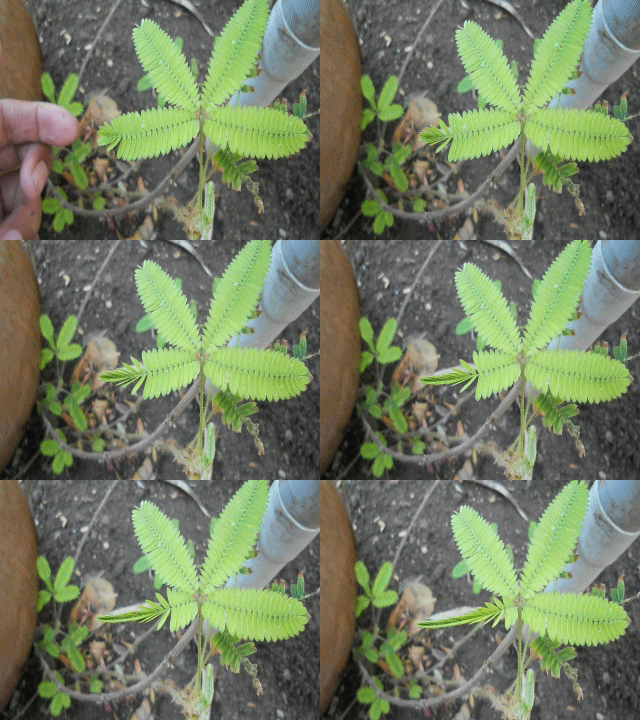
- Playing Dead: When touched, the Mimosa pudica folds in it’s leaves then wilts, making itself less appealing to predators.
- A Touch of Poison. Many plants are poisonous, and can cause symptoms as mild as an upset stomach, or as severe as certain death.
Competitive Advantages:
How does your plant compete for resources? Does it have unique traits that give it an edge? Here are some real-life examples to inspire you:
- “Hearing” Water: Some roots will bend towards sound (phonotropism) in an attempt to find water. This is why trees sometimes wrap their roots around water pipes; the tree hasn’t touched the water, and yet still knows it is there.
- Counting: The Venus Fly Trap is a quick-closing carnivorous plant that will count the seconds between the touching of trigger hairs within it’s trap. If enough hairs are not touched within the right amount of seconds, it will not close. This is because it can take a whole day to reopen a trap and they can only be opened a handful of times, so it is in the plant’s best interest to only close if the chances are high it will catch something.
- Sharing Food: Using the mycorrhizal network(a network of thread-like mushroom roots called “mycelium,” which connects to the roots of trees) certain plant species will share nutrients between each other. For example, during times when the fir trees are still growing but the birch are leafless, the fir will send more carbon to the birch compared to other times in the year.
- Sniffing Out Prey: A dodder is a parasitic plant that hunts for it’s prey using scent.
- “Seeing” Plants: While it is well known that plants will bend towards light (therefore having some sort of way to detect and react to light), what you might not know is that there is a plant that goes beyond that. Boquila Trifoliolata mimics the appearance of other plants, and in one experiment, it was placed near an artificial vine but out of reach. Somehow, the Boquila Trifoliolata still managed to mimic the plant, indicating it was not doing so using scent nor touch.
- Making Friends: Trees will sometimes make “friends,” and will be careful not to cast too much shade over the friend, but will not give the same care to others.
The Appearance:
Ah yes, the part I know many of you wanted to jump to: the appearance. I saved this until here, because how you brainstormed those above can change how your plant looks. For example, if your plant wilts on touch like the Mimosa, it should be flexible.
Start by listing the traits you want, then look to real plants for inspiration. Combine their features and let your imagination fill in the rest.
Uses:
Many fantasy plants have practical uses, often based on real-life plants. I recommend basing your plant’s medicinal properties on real ones to avoid creating a “cure-all” that seem like an unrealistic cheat.
Here are some real-world examples:
- Meadowsweet: Pain relief and stomach soothing.
- Willow Bark: A potent natural pain reliever.
- Honey: Excellent for treating burns and wounds, it also helps prevent infection.
- Yarrow: Useful for stopping bleeding in emergencies.
- Old Mans Beard: Infection Prevention. Simply put over the wound like a bandage.
There is also an extinct plant that might be useful inspiration to some writer out there; Silphium. This plant was supposedly such a reliable contraceptive that the Romans(in theory) picked it out of existence. The plant is even featured on one of their coins.
My Example:

Lantern Fruit is a plant I created for Where They Lurk. It’s a vine that grows in forests, climbing trees and bushes for protection and better access to sunlight. It produces soft purple flowers that turn into the purple fruit that gives it its name.
The citrus and floral tasting fruit (picture peach mixed with lavender) is used in pies, paired with meats, or mashed for drinks. High in vitamin C, Lantern Fruit is often brewed into tea or added to soup for those who are sick.
#writing #fantasy #worldbuilding #fantasyplants #writingfantasy #author