Why Facial Symmetry Looks Different in Photos
One side of your face seems wider in a selfie. You try a different picture, and the imbalance looks smaller. Then a symmetry tool gives the second photo a higher score. What changed: your face, the photograph, or the measurement?
A symmetry score describes selected features as they appear in an image. Start with the two pictures: are you facing the lens in both, are the same features visible, and is your expression similar? These checks give you a way to investigate the difference before interpreting the number.
This article was prepared for Looksmax Scale, whose tool is discussed below. The practical question is how to distinguish a visible left-right difference from the effects of viewpoint, expression, and the rules used to calculate a score.
Start with the features you can see
Begin at the eyes and work downward. Check whether both outer eye corners are visible, whether one brow is raised, and whether the mouth is relaxed. Then look at the cheeks and jaw: does hair hide a contour, or does the head turn put one side partly out of view? Note the feature that looks different, such as a mouth corner sitting higher in this frame.
A symmetry calculation turns those left-right comparisons into a defined method. It chooses a center line, pairs corresponding features, and decides how much each mismatch matters. Understanding those choices helps you read the result beside the picture.
One method might compare the positions of the eye corners. Another might use the outline of the whole face. A third might compare image textures. These are related questions, but they are not interchangeable. A shadow can strongly affect a pixel-based comparison without representing a change in the positions of facial landmarks.
The Looksmax Scale face-symmetry tool checks five groups: brows, outer eye corners, nose wings, mouth corners, and jaw points. It draws a center line halfway between the eyes, at a right angle to the line joining their centers. Then it compares each point with where its opposite partner would appear in a mirror across that line. Gaps are expressed relative to cheek width and combined into a score.
That score summarizes the selected point positions. A visible skin detail or a shadow can matter to how you read the face even when it falls outside those selected points. Keep the original image beside the result to see which question each one answers.
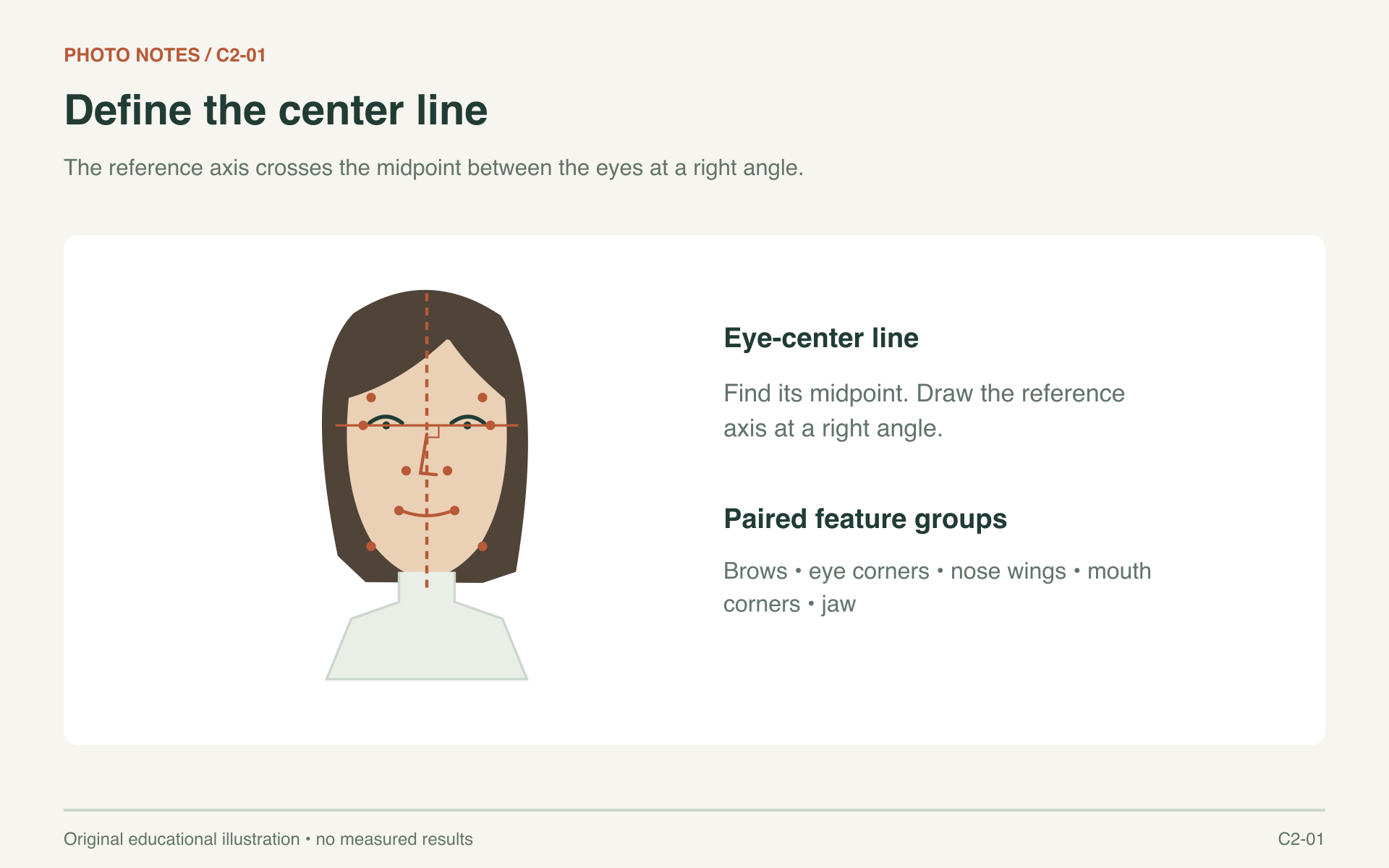
A symmetry calculation needs a defined reference axis and paired points. Drawn locations illustrate the method; they are not predicted landmarks.
A photograph compresses depth into a flat view
Your face has depth. A photograph projects it onto a flat surface. When you turn your head, features that were viewed from similar distances are now seen from different positions relative to the camera. One cheek becomes more exposed; the other becomes less visible. The apparent relationship between paired landmarks changes.
Imagine photographing a pair of doors straight on and then from the side. The doors did not change size, yet their widths in the image differ. A face is more complicated, but the basic distinction between an object and its projection still matters.
Moving a phone closer also changes the viewpoint. Cropping a more distant picture to match a close selfie does not reproduce the close viewpoint. That is why matching head size on the screen is insufficient when comparing symmetry results.
A useful comparison starts with a similar camera distance and a straight-on pose. Keep the camera around eye level, look toward a fixed point near the lens, and check that both sides of the face are similarly visible. These steps reduce avoidable variation. They do not turn a phone picture into a three-dimensional assessment.
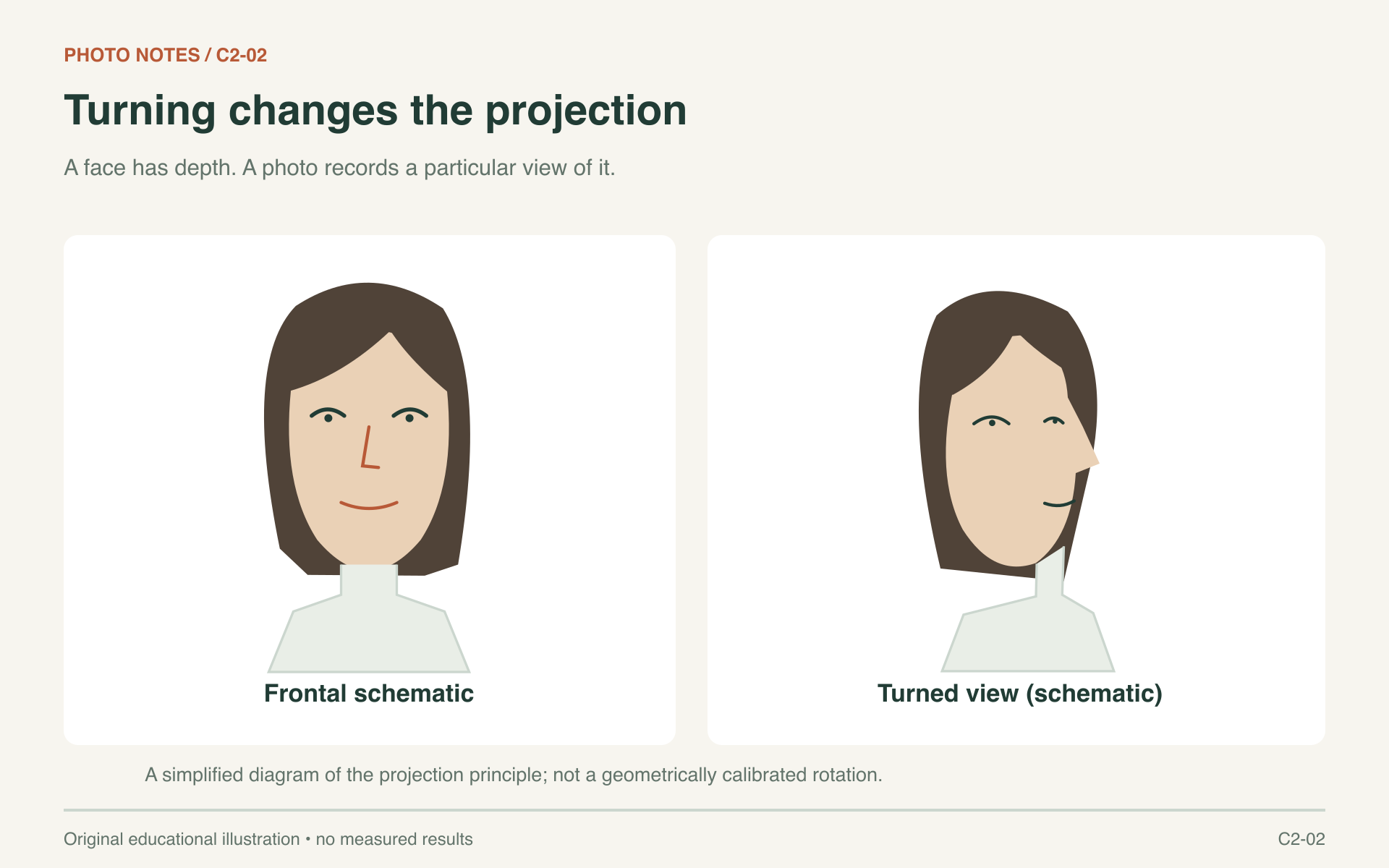
Turning a three-dimensional face changes its two-dimensional projection. Schematic illustration, not a measured pose comparison.
Leveling an image does not undo every head movement
There are different ways to tilt a head. You can lean one ear toward a shoulder, turn your nose toward one side, or lift your chin. Those movements affect a flat image differently.
Rotating a picture can help correct the first kind of tilt. It cannot reveal the cheek hidden by turning your head, or restore the view lost when the chin lifts. A tool may therefore correct a slanted image while remaining sensitive to other aspects of pose.
In the method described above, the center line tilts along with the eye centers. It can follow an ear-to-shoulder lean in the image. Turning the nose sideways or lifting the chin still changes the view the tool measures, so check those movements separately.
You can explore the distinction without turning it into an experiment about your anatomy. Take one reference image, then a second with a deliberate small turn. Label the second as a pose variation. Compare what the picture shows, but do not use the pair to estimate a universal penalty per degree of rotation. One informal comparison cannot establish that relationship.
Expression and scoring choices add their own differences
A raised eyebrow, a half smile, or a moment of jaw tension can move paired points differently. That can be a real difference in the expression captured by the camera. It does not automatically imply a persistent structural difference.
Check expression before interpreting a result. Compare relaxed images with relaxed images, and smiles with similar smiles. Keep hair away from the relevant landmarks. If a point is obscured or poorly estimated, the calculation that follows can still produce a precise-looking number from an uncertain starting position.
Different tools may also choose different normalization rules. Dividing a gap by cheek width produces a relative measurement; leaving it in pixels makes it depend on image size. Tools can weight feature groups differently or convert the same raw gap into different display scores.
Even within one product, an average landmark deviation, a score out of ten, and a position within a reference group mean different things. Never substitute one for another. Before comparing two results, check their definitions, scale, and software version. A matching label such as “symmetry” does not establish a matching measurement.
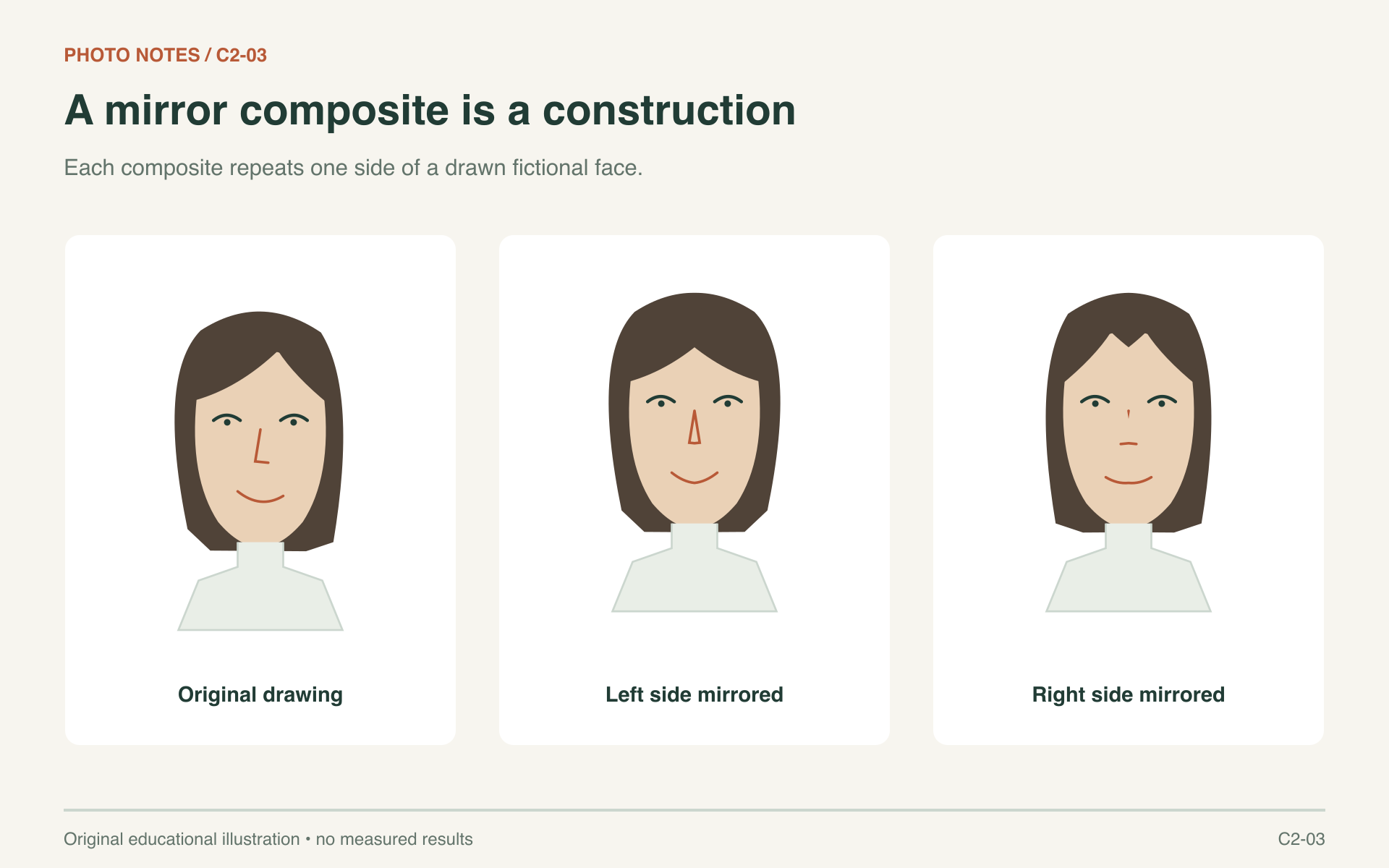
Mirrored composites visualize differences; they are not alternative photographs of the same moment. Fictional drawn face; no score is calculated.
Read the score as one piece of evidence
Research has examined symmetry as one of several features associated with attractiveness ratings. Rhodes's review of facial beauty research discusses symmetry alongside averageness and sexual dimorphism. That research does not make a particular consumer symmetry score a complete measure of how appealing a person looks.
For a useful check, follow this order:
- Save the original image and identify the feature that looks different.
- Check head direction, expression, shadows, and whether the feature is visible in both pictures.
- Read the tool's measurement definition and keep the software version with the result when available.
- Reanalyze the same file to check a repeated reading. Take a new photo when you need a clearer view, and label it as a new input.
When results disagree, start by checking image conditions and definitions. Avoid averaging unrelated scores to produce a supposedly truer answer. If the method is undocumented, that uncertainty should remain attached to the number.
The most useful conclusion may be quite modest: this picture makes a particular left-right difference more visible than another picture does. That is enough to guide a better reference photo. It is not a reason to treat a single still image as a final description of your face.