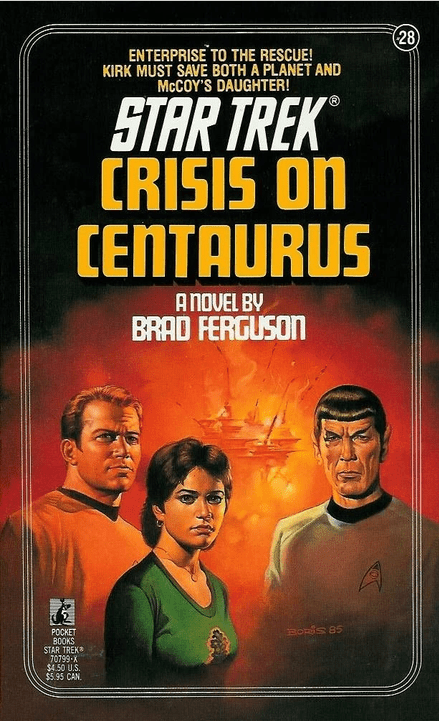
“Crisis on Centaurus” by Brad Ferguson.
Finished “Crisis on Centaurus” by Brad Ferguson.
The story opens at New Athens Spaceport on the Federation colony of Centaurus in the Alpha Centauri system. We get an image of a busy travel hub with somewhat anachronistic product placement, which immediately brings to mind the famous 'soup' debacle. My copy is First Edition, but it was printed in Canada, so if someone with access to an American printing wants to check if they see blatant mentions of brand names like American Express or Coca-Cola, or if that was something that got added by a sneaky printer. Memory Beta mentions them, so I suppose it's in the original manuscript. There are a few oblique references like this lightly peppered throughout. Sears Robuck gets a shoutout later in the book too. Which is a corporation that no longer exists IRL. But this is about as intrusive as they get.
Remember traveler's cheques? If you're on the Gen X side of the Xennial spectrum like me, you might remember them as things your parents might use on vacation, or that you'd see commercials for, but that few if any of us ever had a chance to actually use before electronic payment became a thing. This is relevant because the story begins with a Telarite getting angry at an American Express ATM that took his card when he tried to buy some traveler's cheques, and wouldn't give it back. If American Express paid for this product placement, the joke is on them with the banter that follows the destruction of the machine.
The police investigating this disturbance notice a man sitting nearby with a box. The first cop questions him, and is about to move on when his partner recognizes him as a local hate monger, wanted criminal, and all around piece of shit Isidore Holtzman. As they're about to bring him into custody, whatever Holtzman is carrying in the box blows up. The spaceport and much of the city are destroyed.
Meanwhile, on Enterprise, all hell is breaking loose. A critical computer failure causes multiple systems to go offline, including artificial gravity. They manage to get back into normal working order and are planning to set out for Starbase 7 for repairs, when they receive the news of Centaurus, and are diverted to render aid. There's still no official word on casualties, as the disaster is still unfolding, but there are several on the crew with families on Centaurus, some who might have been at New Athans at the time of the explosion, including Bones' daughter, Joanna McCoy, who was a medical student at New Athens. Her fate is still unknown.
There's a flashback, where we get a glimpse of Kirk and McCoy's first meeting 12 years prior, when then-lieutenant Kirk is injured in combat aboard the Farragut, and McCoy oversees his rehabilitation. Near the end of his medical leave, they take a trip together to Centaurus, and meet McCoy's family, including Joanna, who was a child back then. Kirk makes a claim to a spot of land outside of New Athens.
Back from the flashback, Enterprise arrives at Centaurus, and finds they're unable to approach the planet because the planet's defense system is indiscriminately targeting every ship that approaches, and is believed responsible for the destruction of hospital and relief ships that were due to arrive ahead of Enterprise. Enterprise tanks a nuke, and manages to contact the acting president.
Transporters are offline, as the Enterprise is still crippled by computer failure. And the system is flooded by tachyon radiation from the explosion, so they wouldn't be a good idea anyway. So Kirk, Sulu, and their party take Galileo to meet up with the planetary government, while Spock, Chekov, and their party take Copernicus to the planetary defense center to see if they can shut down the missile defense system.
Uhura takes command for the first time, if you don't count novels that hadn't been written yet. And the novel makes a point to call this out. She's arguably had the conn several times. You could say it's her first time in command during a crisis, but she commanded the ship during the battle of Starbase 12 in the “Errand of Fury” series, and single-handedly commanded from Auxiliary Control during “A Choice of Catastrophes”, both of which were set before this. And while she did take command in an episode of TAS, that event was set in-universe after the novel, which was printed later. So this is the first time Uhura took command in print after already but not yet taking command a year from now. Yes, I'm trying to deliberately mangle that to be funny. But this is probably the first time she would have taken command chronologically at time of printing. Unless I'm forgetting any. So it's not incorrect.
It's revealed that a fringe political movement called the League for a Pure Humanity is responsible for the explosion. This group wants to expel all non-human aliens from Centaurus. You know; racists. And they're not just your garden variety “speciest against fictional aliens as allegory” racists. They're actual white supremacists. They'll tolerate non-white humans to a point, if it suits their short-term purpose. But much like racists in real life, if you think you can trust them because they're not currently targeting you, you're a rube. If you're a member of a historically targeted demographic that they seem to momentarily tolerate while they target someone else, they would eventually turn on you too if they get the chance. Real pieces of shit.
The main tension of the novel is a jurisdiction issue between Centaurus and the Federation. The leader of the “League”, Isidore Holtzman, and many other high-leadership figures died in the explosion. But the remaining LPH leadership figures are still in the wind. Terrorist murder is a capital offense on Centaurus, and the acting Minister of Security Nathaniel Burke wants them to face Centaurian justice, and possibly the death penalty. But because an antimatter device was used in a terrorist attack, the Federation has jurisdiction. And Kirk is under orders to apprehend them and bring them back to Earth for trial. Federation civilian court has no death penalty, so if convicted in a Federation court, they'll be sentenced to a cushy rehab colony. So the race is on between Kirk and the local Centaurian authorities to apprehend them first.
Meanwhile, Spock's party manages to shut down the defense system so that ships can approach the system again, and sets out in search of survivors. They find a makeshift settlement of survivors, and begin the process of supplying aid.
For a novel about a disaster response, I figured there'd be a bit more urgency in responding to disaster. Kirk's party spends a night at a hotel in McIverson, another town some distance away. Sulu even manages to spend a night on the town, and the nightlife is described as a town going about their lives as though the capital city of their colony wasn't rendered a smoking crater less than a week ago. Spock and Chekov's party, after shutting down the defense system, spend a night camping out before setting out the next day on a search for survivors. The local government is so inept that the author feels it necessary to address in the epilogue.
The book was released in 1986, well before 9/11. But 9/11 is probably one of the more prominent events that many of us in the west, particularly in the US or Canada could relate to, and more likely to draw comparison. And as someone who remembers 9/11, many of us were in shock for well over a week, and the effort on the ground was around the clock. A novel like this has to hit different after 2001 than it would have before. So that kindof lead me to feel that the tone of the novel was a bit off. Though granted, for my generation and younger, it often feels like we've been living a prolonged series of disasters ever since. Many of them inflicted upon us by our own governments and their corporate overlords. So in that sense; well played, novel. Well played.
My guess is the author felt that other plot lines were more interesting than a prolonged disaster response sequence. And narratively, it was a good choice, and the novel is better for it. But it makes that aspect conspicuous by its absence.
There are a more than few vestigial remains of a different novel that was planned, but then decidedly changed in the process. And I don't disagree. Some of those threads probably weren't going to go where they wanted them to, and had to be tied off.
When we last saw Joanna McCoy chronologically in-universe, it was in the Star Trek Legacies novel “Best Defense”. Another novel that hadn't been written yet. There, she is a smart, and capable medical student who keeps getting taken hostage, but doesn't fold into the damsel role easily. She's an active participant in the plot. If you want to get to know her better, I'd suggest that novel over this one. In this one, she's a little busy, providing medical assistance to the wounded at the recovery center. If she were a real person, who could blame her? But she's not a real person. She's a fictional character who we're supposed to care about, and not just vicariously though McCoy. Who also doesn't heavily feature in ⅔ of the novel. She's still smart. Still capable. Just… you know… kinda busy. So we get Kirk and McCoy's relief on finding her alive, but not much more than that.
Plot points that do get explored are still engaging. I could nitpick them to death, if I wanted to dwell on it, but I've been procrastinating this entry enough as it is. There's the theme of justice versus revenge; Should the surviving LPH members be executed by the state for the murder of millions? Or is it right that they be sentenced to a soft life on a Federation penal colony, even if it's a life sentence? Is the death sentence justice, or just revenge? It's a tension that doesn't get answered easily, and is ultimately left up to the reader. And I suppose that's the right choice. There's not supposed to be an easy answer; just a scenario to consider.