Deconstructing an Invented Sin: Masturbation
Why is it important to examine this question? — It exposes flawed approaches to defining sin, flawed ways of discerning good and evil, which in turn distracts and disperses attention from what is essential: the struggle against real sins and the consistency (rationality) of reasoning. The latter concerns calling things by their proper names; Christians are called to straightforwardness in their judgments (Matt. 5:37): if a pyramid before us is black, we say it is black; if it is white, we say it is white. If something before us is a sin, we consistently avoid it as evil; if it is not a sin, we accept it as a good (acceptable) thing.
How Self-Gratification Became a Sin
Inattentive biblical scholars of antiquity extrapolated the sin of Onan — an Old Testament figure who interrupted the act of intercourse — onto any ejaculation without the purpose of procreation. Medieval moralists upheld this determinism: they pushed masturbation beyond the margins of the acceptable, and unprofessional physicians echoed them, claiming that the act was harmful to health, led to blindness and madness, caused hair to grow on one’s palms... Such radical alarmism from the “WHO” of the day, fueled by influencers and mere loudmouths, sowed a veritable panic throughout Victorian society! Boys (children) had it hardest: in addition to verbal sermonizing and the whip, “restraint devices” were “manufactured” for them — often of an overtly sadistic character: with spikes, clamps that plucked out pubic hair, metal cock-cages, bells; and some anti-masturbation activists even proposed performing surgery — implanting a silver wire into the foreskin in such a way that it would cause acute pain during an erection. Special bland diets were devised for children, as it was believed that fatty, spiced food was “arousing.”
The spread of anti-masturbation sentiment in Europe and the USA was driven by weak or absent critical thinking: a few publications under sensational headlines from authorities or even anonymous writers sufficed to infect people with collective hysteria. The closedness of communities and the lack of information created a veritable hothouse effect for irrationality — people simply had no way to verify the data and found themselves in an echo chamber. Collective psychosis, the herd effect: real psychological traps into which anyone can fall, regardless of education level or historical era. Most likely, those “inventions” for the prevention of masturbation largely remained on paper as patents, or were displayed as prototypes. Mass production in the modern sense did not yet exist, and custom-made orders cost money that the average European could not afford to squander on some contraptions — and so he confined himself to moralizing and frightening his own children.
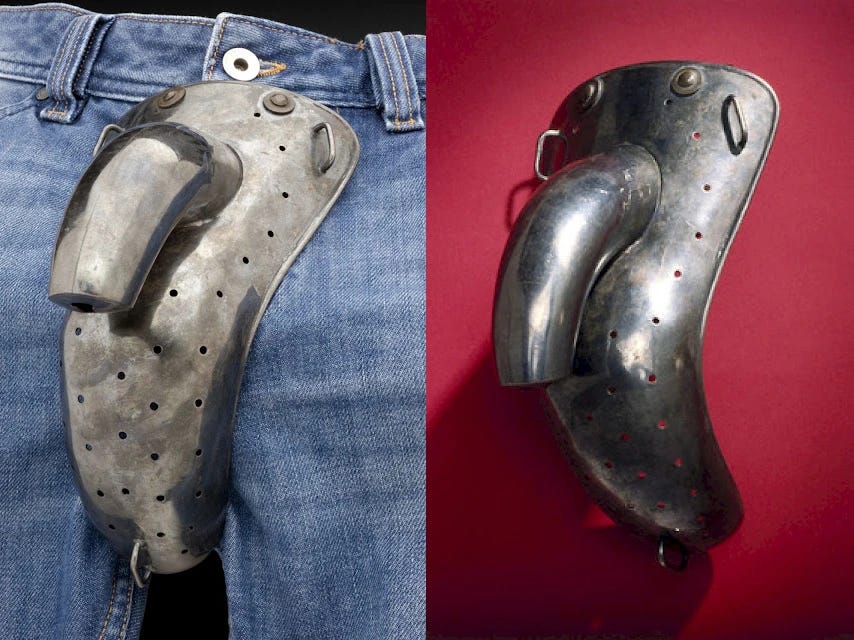 By the designer’s intent, this sadistic instrument is fastened at the groin with four little straps and does not interfere with everyday life, nor does it spoil one’s clothing. Urination is possible without removing the apparatus (or even one’s trousers), after all, anyone who decides to wear such a device should not be bothered by trifles like urine. The wearer of a cock-cage is visible from afar, even when he is not dressed in leggings. The device also helps one push through the crowd at the marketplace; during the storming of a castle, a soldier equipped with a cock-cage marches ahead of the battering ram; in the kitchen, the cock-cage serves well for straining pasta, and it is also handy for cracking nuts. In a word, this thing is useful not only for torture, but in everyday life as well.
The effectiveness of all those anti-masturbation measures can be easily illustrated with one meme:

What was the attack on masturbation grounded in? Above all, in ignorance. The physicians of that time simply did not know how human body was constructed, and those who resorted to religion for their critique failed to grasp the essence of Christianity — the evangelical spirit: grace, forgiveness, love. Physicians linked masturbation to conditions for which they could not find the true cause. Religious moralists relied on the notion of self-defilement, a product of the Jewish magical consciousness, which missed the main point: God created man in His own image and likeness, and therefore man cannot contain within himself mechanisms of self-defilement — something that defiles him uncontrollably (like nocturnal emissions or sexual desire). What defiles man is licentiousness and adultery; those are sins grounded in sexuality that proceed from his heart — not what he does with his own body. The Apostle Paul says in his First Epistle to the Corinthians: “the body is a temple of the Holy Spirit” (6:19) — and it is well known that temples come in all manner of architecture: some prefer Gothic, some Baroque, some neo-constructivism, some cannot accept minimalism in temple architecture — but none of this affects whether the temple remains a temple of the Holy Spirit regardless of someone’s aesthetic preferences. It is for this very reason, among others, that piercings and tattoos are not a sin.
Interestingly, before the modern era, the English-speaking (Latinized) milieu used the phrase “nocturnal pollution” to denote emissions, where “pollution” derives from the Latin “pollutio” — “defilement” — and it most often appeared with the adjective “nocturnal” (nightly), which betrays an all-around misunderstanding: emissions occur not only at night but during the day as well, and they do not “defile” man. Later this misandric archaism was replaced by “nocturnal emission,” which removed the irrelevant negative connotation (“emission” being the neutral “discharge”) — though it retained the inaccurate “nocturnal.” In the 18th century, on the wave of the medicalization of self-gratification, the term “self-pollution” appeared as a synonym for “masturbation”; thanks to common sense, it never caught on.
The absurdity of the fierce medieval (in the broad sense) sinification of the act can be reduced to the following formula: just as masturbation is a terrible sin, so is deliberate defecation or urination. This is an error in every sense: biblical, biological, and logical.
Ancient (Pagan) Roots of Masturbation-Canceling
If we dig deeper, we run into ancient philosophy — into the Stoics and the Neoplatonists, who held the material world in contempt (e.g., Plotinus), considering it the “bottom of being,” and the body, accordingly: shackles and a burden that must be cast off in order to be set free. The ancient philosophers believed that the soul (human person) is a slave of the body, that the body enslaves the soul through the passions in particular; accordingly, the body and the material were identified with evil. Later, many of these ideas migrated into the Christian worldview of major denominations and crystallized into their asceticism as a foundation. The expediency of such borrowing from pagan thought is questionable. What is the fundamental error of those philosophers? Not knowing God, they did not know of His infinite mercy and love, of the fact that He is good and is the Creator of the Universe; and so they mixed good with evil, called God’s creation — the Universe — evil, and called the “garments” (physical bodies) that God made for humanity in Eden evil as well. Plotinus calls inanimate matter “ugly” in his treatise “On Beauty” and in the same place says: “So, we may justly say, a Soul becomes ugly — by something foisted upon it, by sinking itself into the alien, by a fall, a descent into body, into Matter” — that is, the soul, upon entering the body (matter), is thereby, as it were, defiled by it, becomes “loathsome.” This is nonsense, since “soulless” matter: mountains, the ocean, valleys, the starry sky, the cosmos itself — is unquestionably a manifestation of beauty and goodness. Genesis 1:31 sums up God’s work on the Universe: “And God saw every thing that he had made, and, behold, it was very good.” Likewise, human body is nothing vile, nothing that can defile the soul; person defiles himself with evil — with evil deeds and evil thoughts (Matt. 15:19-20) — while the body serves him only as an instrument. Is the hammer to blame when you strike your own finger with it? Physical allurements can cause pain through passions, but only when man (the soul) lacks self-control and caution in handling the “hammer.” Matter is incapable of defiling the soul for yet another reason: the material universe cannot contain the immaterial soul in principal. The soul, having descended into the material, becomes, as it were, a witness to the material, yet not a part of it — still less such a part as is utterly absorbed by the material. Plotinus groundlessly calls the physical dimension the “bottom of being” — groundlessly, for it is impossible to judge the world objectively without stepping beyond its boundaries. The true “bottom of being” is alienation from God, a conscious turning away from goodness, a plunge into evil, into sin; such alienation is a plunge into slavery, is self-shackling — that is truly hideous! If being has a “bottom” at all, it is hell, not our world. Finally, a simple logical inference about the dimensionality of our world refutes Plotinus with his “bottom of being”: we live in a three-dimensional reality; it is logical to suppose the existence of two- and one-dimensional realities, which would then have to be located below Plotinus’s “bottom.”
Those ancients saw the body as a prison, whereas the Apostle Paul calls the body a temple; the ancients desired to “undress,” to free themselves from the body, but Paul says: “For we who are in this tabernacle [the body] to groan, being burdened, not for that we would be unclothed, but clothed upon, that mortality may be swallowed up by life” (2 Cor. 5:4). Do you catch the radical divergence? We understand the body as beautiful garments (body aesthetics occupies a vast sphere within art and sport) made for us by God, which, however, are beaten, like moth-eaten fabric, by our imperfection, our sinfulness, and our departure from God; and we want to get rid of sinfulness, not the body, of those shackles through which we hate ourselves (John 12:25); we are drowning in helplessness, and yet we hope in the Son, the Deliverer (John 8:34-36). Jesus did not get rid of His physical body after the resurrection. Recall the episode when He entered the room where His disciples had gathered, and Thomas was among them, who could not believe that Jesus had risen but wanted to verify everything with his own eyes; then Jesus showed him His hands and the nail prints (John 20:25–27). Jesus convinces the disciples that they are not seeing a spirit: “Behold My hands and My feet, that it is I Myself. Handle Me and see, for a spirit does not have flesh and bones as you see I have” (Luke 24:39). Indeed, Paul says the very same thing regarding the body of a Christian when he expresses the desire to be “swallowed up by life,” to be under the sway of the life of Jesus, rather than decay and death.
Another nuance: pre-historic philosophers considered sensory pleasures “low” and animalistic, but feelings belong to the soul, not the body. Qualia are an experience of the soul; the body merely transmits information, while it is the soul that perceives and interprets it, and the soul itself feels pleasure or displeasure, not the body. Therefore, by calling sensuality “low,” they attributed the “low” to the properties of the soul, which is unacceptable since the soul — man — was created in the image and likeness of God. In general, the concept of “low” sensations contradicts, once again, the logic of those wiseacres: they attribute sensations to the corporeal, as if matter (evil and vile according to their own notions) could give birth to something pleasant, such as the taste of good food or an orgasm. But how is that possible when matter is bad? Does a bad tree bear good fruit? (Matt. 7:17).
Thus, pleasant sensations are rather a “sample” from above — you know those perfume samples in a store? — such a sample is given to man, to the soul, from high realities to distinguish pleasure from displeasure. We can preserve this sample for God’s sake, meaning we can practice asceticism, or we can also use it for God’s sake with gratitude to God every time we “spray” that sample: “He who observes the day, observes it to the Lord; and he who does not observe the day, to the Lord he does not observe it. He who eats, eats to the Lord, for he gives God thanks; and he who does not eat, to the Lord he does not eat, and gives God thanks” (Rom. 14:6).
One cannot judge person for his preferences; everyone evaluates their being in their own way, everyone walks to God by their own path (on the narrow way (Matt. 7:14)), and such a path is mostly individual, it is your path to God, and if you decide that some pleasure in life is “low” or sinful, this conclusion is relevant exclusively to you — you believe in it, and you will receive according to your faith.
Take a panoramic look at those primordial speculations; read at least the foundations of Plotinus’s teaching on Wikipedia: it is an absolutely mechanistic ideology, utterly devoid of feeling — there is no heart in it! With a stone face, the author speaks of the soul’s desire to be divorced from the material and united with the immaterial, to return to a transcendent homeland — but you do not believe this author; it seems he does not himself believe what he says. His words sound like the clatter from the entrails of a robot; there is nothing human in those words — they are alien to man, alien to one who has a heart. That is why ancient wisdom is incompatible with Christianity, with a religion that has a heart. The luminaries of ancient philosophy called philosophers and sages those who battled against their own body as against sin; yet the struggle against one’s own body is not a struggle against sin! The material is incapable of sinning. In Christianity, a wise man may be called one who masters his body, subordinates it to his will, skillfully governs it — and this professional does not despise his body, just as an artist does not despise his brush, a carpenter does not despise his chisel; on the contrary, he cares for his body so that it may be able to carry out its principal task: God’s commandments. Jesus commanded cutting off that part of the body which leads one into sin (Matt. 5:29-30); the ancient ratiocinators command cutting off everything indiscriminately — whether it leads into sin or not, simply cut off everything, mortify the body. Will a dead body be capable of praising God? “Wilt thou shew wonders to the dead? shall the dead arise and praise thee? Selah.” (Ps. 88:10). If so — by all means, cut off everything; if not, keep what will help you praise God in word and in deed. When a Christian cuts off a part of his body that impels him to sin, the Christian understands that the body is not at fault — the temptation is, the allure, the motion of the heart: the soul’s intention. This commandment demands unconditional decisiveness in the struggle against sin and hatred of oneself (John 12:25): whoever pities himself will not be able to overcome the fear of suffering or death, and sinfulness takes advantage of this. Self-sacrifice for the sake of lofty goals — love (John 15:13), the Kingdom of Heaven (Luke 9:62), faithfulness to Christ (Rev. 20:4) — is not identical to a struggle against one’s own body; in Christianity, the body helps achieve those goals, for like that grain of wheat (John 12:24), it is sacrificed unto the fruits of eternal life, and herein is revealed the true value of the material: it imparts to the spirit the potential to blossom into a tree bearing good fruit; the suppression of this potential or its improper application diminishes or wholly deprives it of fruit. Matter contains no sin within itself — a stone cannot be sinful, and neither can the body. If you are inflamed at the sight of a stone, the cause of the inflaming lies not in the stone, not in the body, but in your heart, in your soul.
Sin is always begotten by a heart that is weak toward good, by a soul with flabby muscles of the will — and only afterward is that sin realized through the imagination or through a physical act, carried out by means of the physical body.
Thus, to consider the body sinful, or capable of its own accord of causing the soul to sin, is a fundamental conflation of cause and effect. It is also necessary to understand that the flesh demands nothing bad: bodily thirst needs water, bodily hunger — food, bodily fatigue — sleep; sexuality, too, manifests itself through need and has its own paths of satisfaction. Recall Mark 14:38: “Watch ye and pray, lest ye enter into temptation. The spirit truly is ready, but the flesh is weak!” — and explain to me, how can a “weak flesh” overcome a ready (strong) spirit? Evidently, it battles with itself; and so one must not shift the blame for sin onto the body — that is the same as blaming the bullet for the killing.
As can be seen, the problematic of the sinification of self-gratification has a broad perspective and reaches down into ontological questions, where, having passed through subjectivization, it becomes an aspect of the animality — or, through objectivization, becomes an aspect of sexuality, a manifestation of the synergy of the soul’s and the body’s constitution.
What Was Onan’s Problem?
In ancient Judea, the Jews had a strange law of levirate marriage, under which a younger brother was obliged to beget a child with the wife of his elder brother if the latter had died without leaving offspring. Even if the younger brother was already married, he had to lie with a woman who was not his wife... Onan was such a “younger brother”: his father sent him to Tamar, the wife of the deceased Er. Onan agreed to fulfill the law, but practiced coitus interruptus, for he did not want to give Tamar a heir. It was precisely this — the interrupted act of intercourse — that someone took for masturbation... The error is entirely obvious and requires no comment: onanism is not the same as masturbation.
Masturbation is not mentioned in the Bible at all — neither in the Old nor the New Testament.
The story of Onan is told in Genesis chapter 38; let us try to uncover the issues it raises. To do so, one must know the historical context. Childless widows in ancient Judea held a highly precarious socio-economic position: without an heir, they could not inherit their husband’s property (it reverted to the husband’s family) and lost the possibility of merely feeding themselves (women, with certain exceptions, did not work); moreover, a widow had no right to remarry until the rule of levirate (yibbum) or the ritual of halizah (refusal) had been performed. When, for whatever reason, yibbum or halizah was not carried out, the woman remained in the status of an “eternal widow” and had to return to her father’s house — but there she might not be taken back, in which case she was condemned to a life of beggary.
In those times a barren woman faced social shaming: barrenness was considered a great disgrace and a punishment for sins. This is an important point for understanding the consequences of Onan’s failure to fulfill the levirate: Tamar would have been considered barren.
And although Judah’s family (Tamar’s husband) provided Tamar with everything necessary, without an heir her future looked uncertain. It is therefore hard to believe that Onan was failing to fulfill the levirate with Tamar’s consent — all the more so since later, after Onan’s death, Tamar tricked Judah into lying with her. And if there was no such consent from Onan’s side, then his behavior constitutes a form of violence — sexual exploitation.
It was for this — the mistreatment and exploitation of a widow — that Onan was, most likely, punished with death, and not for “masturbation.”
What Masturbation Actually Is
It is the satisfaction of a sexual (biological) need. The functioning of the body’s mechanisms in human is subordinate to precise rules, interference with which can lead to suffering or death. For example, a human being needs food and feels hunger when deprived of food; this is a vital rule — if one disregards hunger and does not eat, the body perishes. The same holds true of thirst and sleep. Sexual desire, too, is “built into” the body’s mechanisms; these desires arise neither by suggestion nor through sinfulness — they arise of themselves and are absolutely natural; nevertheless, a human has the capacity to control them, and if necessary to ignore them.
Sexuality, though not categorically among the vital needs of the organism, is nonetheless part of human biology and of human soul. Sexuality is connected with love; it is a manifestation of eros, which itself derives from agape — this proves that sexuality belongs among the properties of the soul.
Mechanically, masturbation is no different from eating, sleeping, or drinking; accordingly, if masturbation is a sin, then the mechanical and deliberate satisfaction of other biological needs is a sin as well. One must also take into account its autoreflexivity — that is, this process concerns no one except the one performing it, and such processes, as we have already established with the “body as temple” example, are, on the whole, non-sinful.
Nor can this process be called objectively obscene — no more than defecation or flatulence. Subjectively, self-gratification can be aesthetic or unaesthetic, which bears on shame; for the most part, however, the aesthetics of masturbation are determined by age and grooming: and an elderly man, or a man with an ungroomed body, engaged in this occupation will look less aesthetic than a young, well-groomed one.
In the wild, self-gratification is widespread among at least 400 animal species — among apes, dolphins, horses, and bats in particular — which likewise underscores the naturalness of the process. There is no point in drawing parallels here with infanticide, cannibalism, or other manifestations of radical behavior in the animal kingdom, since our topic lies outside the category of violence and bears a private character. Anyone who claims that masturbation is an act of animal behavior commits a crude error, for by the same logic eating and drinking would also be animal (shameful) behavior — since animals, like humans, eat, drink, breathe, sleep, and have sex. The common features of animals and humans are not shameful; they are the result of sharing life within the paradigm of an organic body. That is why, for example, the design of the organic body of man has many elements similar to the design of the organic body of an animal: two eyes, two ears, one mouth, one nose, four limbs, and so on. What truly constitutes shameful animalistic behavior is the display of aggression, violence, and killing.
Modern medicine refutes Victorian amateurism and emphasizes the benefits of masturbation: in particular, frequent ejaculations (8+ per month) help maintain (2, 3, 4) prostate health, which, according to studies, is associated with a decrease of prostate cancer risk of approximately by 9-20 % in relative terms, the release of hormones relieves stress, improves sleep, and produces euphoria.
A Bit of Polemics on Harm: Real and Conjured
Some counselors recommend entering into marriage in order to avoid the “sin” of masturbation — which is entirely inappropriate, if only for the reason that person’s first attempts at self-gratification occur before puberty, in infancy. Of course, these attempts are devoid of sexual context and are performed rather in the process of exploring one’s own body, for the sake of obtaining pleasant sensations and relaxation; they are performed reflexively — but technically, this is masturbation.
As John Paul II aptly noted in his 1994 “Letter to Families”: “The person can never be considered a means to an end; above all never a means of “pleasure” — that is, one must not use a human being for the attainment of one’s own goals, especially when it comes to “pleasure.” Such a utilitarian attitude toward a person is overt egoism, disrespect, or even exploitation — and it was for sexual exploitation, evidently, that Onan was punished! So the advice to “marry against masturbation” is simply harmful — it distances person from love, for the edifice of the marriage vow must be built on love, not on the desire to satisfy biological needs. A marriage “against masturbation” is a marriage of convenience — the same as those contracted, for instance, for money.
To argue the harmfulness of self-gratification by the acquisition of a psychological or physical addiction is futile and illogical, because everything — any activity whatsoever — is capable of inducing some form of addiction; and besides: in an addiction, the subject is at fault, not the consequence (masturbation), but the lack of self-control (the cause). Immoderation in food leads to obesity; lack of restraint in gambling, to ludopathy; carelessness with alcoholic beverages, to alcoholism; people become addicted to smartphones, video games, the internet. In themselves, alcohol, gadgets, food, and games are good fruits, and addiction does not make them cease to be good; what is bad is the addiction itself — the excess in use and consumption.
Imagination and Pornography
Some may agree that purely mechanically masturbation is not a sin, but that the sinfulness lies in sexual fantasy or in watching pornography; such a position is half-true. Here it is important to distinguish between an action that arouses desire and an action that does not arouse desire.
“But I say unto you, That whosoever looketh on a woman to lust after her hath committed adultery with her already in his heart” (Matt. 5:28). Although this concerns adultery (marital unfaithfulness), it nevertheless reveals the principle of Christian ethics in overt (objective) and covert (subjective) acts. Conduct in objective reality must correspond to conduct in subjective reality — for one can “look” upon an object of desire with the eyes of the body as well as with the eyes of the soul (in the imagination). This principled stance lies in the straightforwardness, the sincerity of the Christian, who does not bend his soul, who is harmless as a dove (Matt. 10:16). When you pledge a vow to your beloved — to share your very being — you must hold to that vow not only in actual reality but in imagined reality as well, in your fantasies. Would we call a Christian sincere who repeats aloud the commandment “Thou shalt not kill,” while in his dreams pronounces death sentences?.. And what if those dreams are reinforced by a desire for revenge, a desire for violence (the urge to inflict pain)? The imagination is a creative field for “painting,” but desires arise in the heart, in the wellspring of feelings; the begetting of sinful desires by the heart is a serious cause to reflect on the purity of one’s wellspring. As we know: one and the same spring cannot send forth both sweet water and bitter (Jas. 3:11). So when the spring produces bitter water, it is an obstacle to the creation of sweet water, to the creation of good. The imagination is fully subordinate to the mind, and the mind often leans upon the feelings; therefore do not think that everything “painted” in the imagination is a priori innocent. The imagining of sinful scenes and actions, when it is grounded in sinful desire, testifies that the bitter water has overflowed the bounds of the sensory basin onto the field of the rational; such a course of events must be accompanied by a loud alarm signal.
With adultery all is clear — but what if a man has no partner? Even in that case, to place real people in one’s sexual fantasies is a presumption — impermissible within the bounds of culture and high self-awareness. Never mind that it is impossible to imagine something real precisely, since you cannot copy a real image into your imagination, only its reflection; to trifle with the imagination means to trifle with one’s own upbringing. On the whole, however, sexual fantasy (within the bounds of ethics), like the watching of (legal) pornography, is not a sin. An adequate sexual fantasy depicts a natural act; the same is done by pornography in which all the participants act with consent and publish the material for the general public.
Note carefully: the phenomenon of commercial pornography itself — people having sex for money with various partners — is a form of prostitution (fornication), that is, the selling of one’s body for money, and this is not normal. Non-commercial pornography (without changing partner) can at most be called shamelessness. Becoming a witness of something abnormal is not a sin: no sin comes from watching a horror film or an action movie depicting killing or torture; nor is it a sin to watch real footage of military operations, a recording from an FPV drone camera. One must, however, keep watch over oneself, so that such videos do not evoke a pleasant feedback in the soul. A video from the battlefield, for instance, ought to evoke disgust and revulsion in the soul — the same goes for horror films; there is a difference, though: horror films are a product of artistry, of fiction, while war footage is real, and this exerts far greater pressure upon the mind; depending on the constitution of one’s soul, this pressure is capable of breaking through the psyche’s protective mechanisms and inflicting psychological trauma. The same holds true of realistic pornography — especially of the illegal or unaesthetic kind: such videos are capable of traumatizing the psyche. Realism in pornography is therefore better avoided; preference should be given to animated genres — and better still, to abstain from explicit content altogether.
A second important note: if we define commercial pornography (with real actors) as a form of prostitution, then paying for such content makes one part of the clientele of that service. Paying for solo content — on some “OnlyFans,” say — is a lesser fault, since this genre is free of the sin of fornication (intercourse with various partners); yet this sponsorship is all the same, at the very least, financial complicity — and at the very most, a form of (visual) prostitution: the buyer purchases (virtually) another person’s body for sexual gratification, or (if he is not himself a consumer of such content) sponsors (encourages) that activity. The distinction between the nuances lies in the presence of desire for intimacy with the person who has been paid money to display nudity: if the imagination is goaded by such desire and paints a scene of a sexual nature with that person, this is rather visual prostitution; but if that person serves merely as a trigger of arousal, while desire and imagination stand apart from the person — then it is financial complicity.
The problem with funding commercial pornography (with real actors) lies in the absence of fiction: even when it is a fictional product (the events unfold according to a script), the people on the screen are performing a real act — and this is the principled distinction between a pornographic film (fictional) and a feature film: in the latter, everything is fiction. This rule is general and admits of no exceptions. Compare the purchase of fictional content — a war film, for example — with the purchase of the real thing, when someone donates to FPV drones and then watches on YouTube a clip in which “his” drones tear people apart: the former is familiarization with the topic; the latter is complicity in it. The same with pornography: either you pay for real content (whether framed fictionally or not) and become a financial accomplice of a real act, or you pay for full fiction content (animation (no real act)) and just support the author’s creativity.
Advertising on pornosites cannot be called a form of funding pornography, since the advertising is displayed without the viewer’s consent, and besides, no one forbids the use of an ad blocker.
Let us now examine the main theses of the critique (the sinification) of pornography (in generalized form).
- Sometimes the voyeuristic character of pornography consumption is pointed to, but this is incorrect, since “voyeurism” means, above all, “peeping”; the viewer of pornography, however, is not peeping at the events, for all the participants in them are aware of what is taking place. And what of the feature film in which the director shows a scene (intimate or not) through a keyhole? Such an effect can indeed make the viewer feel like a voyeur.
- We have already spoken of addictions, and yet I have not heard of anyone watching porno for 6-8 hours a day, but that is precisely the “average screen time” today for social media, TikTok, YouTube; algorithmic feeds drag people into dopaminergic traps, immerse consciousness into a kind of trance, into doomscrolling. In this state a man loses count of time, drops out of reality, however, no one is in a hurry to criminalize social media? “Active” watching of pornography has a “biological safety catch”: the refractory period. What safety catch do social media have?
- To speak of the instrumentalization (exploitation) of person (in porno), of the loss of subjecthood by the characters on the screen, of the absence of empathy toward them — today, in an age of technological development, when visual content is created by AI, or by the efforts of animators, artistsand 3D modelers — is hyperbole and anachronism. What harm is done by objectness (superficiality) in the watching of hentai, when all the participants are fictional? Consider, too, that pornography can be part of a feature film, a documentary, architecture, or sculpture. Or “that’s different”? :)
- Simulacra and hyperstimulation in animated porno can indeed lead one astray, but this is nothing exclusive to pornography: just look at Instagram with its perfect bodies, luxurious living, and total success?! Or at the AI art, which is for the most part idealizations of images.
Ultimatelly, there is no necessity for pornography when one has imagination. In some cases the use of pornography is justified by aphantasia or by the need for a dopamine boost (with long abstinence, day-long dopamine dips with psychosomatic effects are sometimes possible; short sessions of (so as not to provoke daytime emissions) “passive” porn viewing (starting with the lightest (static), such as adult manga) may help restore the dopamine balance and ease the condition), but even then there are countless genres of pornography besides the realistic one (with real actors); and therefore the notion of pornography as a genre of “exploitational” cinema that devalues human person and relationships is a generalization that falls outside the focus of objective critique.
Why Self-Restriction Is Needed, and for Whom
Truth be told, why these challenges (the NNN type), these acts of self-restriction outside asceticism? The answer is simple: self-knowledge and the training of the muscles of the will; the possession of self-control allows one to become that athlete who has perfect mastery of his body and knows how to walk the tightrope.
Asceticism should not be considered something proper exclusively to the monastic way of life: in Christianity, everyone ought to practice self-control, since Jesus Himself fasted forty days in the wilderness (Matt. 4:2), and more than once commanded His disciples to fast (Matt. 6:16-18; Matt. 9:15; Matt. 17:21); Luke in 2:37 emphasizes fasting as a form of service to God. The cutting off of one’s own bodily parts (Matt. 5:29), or making oneself a eunuch (Matt. 19:12), can likewise be understood as a form of fasting.
Returning to the “perfume sample,” let us uncover the motivation for keeping and using it. The meaning of sacrificing the temporal lies in this: to have the capacity, the hope, of receiving the eternal. However, it cannot be said that the one who sacrifices the temporal will infallibly receive the eternal, and that the one who does not sacrifice the temporal will not receive it. No, the opportunity to receive the eternal belongs equally to the one who sacrifices everything and to the one who sacrifices nothing. Do you remember Matt. 19:25-26? — on his own, person cannot pull himself up by the hair out of the quicksand; only God can pull person out of a mire, and therefore it is important to understand the personal character of one’s relationship with God, a relationship in which there is no place for justification by the deeds of others. Christians are not those workers who peer into the palm of their neighbor receiving his pay from the master of the vineyard (Matt. 20:12-16); you cannot say: why did he receive the eternal without sacrificing the temporal? If you see value for yourself in sacrificing something temporary, that is your choice; whether or not to make such a sacrifice is a personal decision, but it is God who decides what each person will receive in return for these sacrifices.
A prohibition in upbringing, or self-upbringing, is effective only from the standpoint of ratio: a right prohibition of masturbation must rest exclusively on asceticism; in all other cases self-control is to be applied, as a safeguard against addiction. How does one recognize an addiction in oneself? Try abstaining from self-gratification for one month a year, by joining the NNN challenge, for instance. If no problems arise with this, you are free of addiction. If it does not succeed, try to limit the number of masturbations to 1 per week for a month, next year in the same month let there be 3 restricted weeks, and 1 completely without masturbation, then 2-2, finally 1-3, and for the 5th year there should be fully dry month. And if even such gradualness proves too difficult, then your self-control is in need of leveling up. In what follows, after weighing the risks (for instance, those concerning the prostate and dopamine), this step can become a foothold in “drying out” the month opposite November — May, and further, according to one’s own plan of ascetic exercises.
A Straight Reply to Critics
Should someone reproach me with “temptation” (Matt. 18:6), I will answer: temptation is life in a lie. One must not hide the light of truth with the thought of “good intentions” — such a thought rests on the irrational, on sand, and on it no sturdy edifice of Christian life can be built. To brand masturbation a sin while understanding its non-sinfulness, for the “safeguarding (salvation) of people” through self-restraint, is deception; accordingly, to teach abstinence from masturbation as from a sin is to teach a lie and a self-deception — and there is no salvation in deception. Christians must go about with their lamps lit (Matt. 25:1), must preach the truth from the housetops (Matt. 10:27), not hide away out of uncertainty, shame, or fear. Having gone up onto the roof and declared: “Masturbation is a sin!..” — you must finish the phrase either thus: “...For me,” or thus: “...Because...” Without rational grounding, any speech is mere rhetoric. A speech that does not rest upon truth (the objective) is rhetoric. The medievals once tried to argue the sinfulness of self-gratification from the housetops, and they arrived at the absurdity of metal cock-cages, because that argumentation was devoid of truth.
I am tempting no one into sin, since, firstly, the topic of this article — masturbation, is not a sin; secondly, the de-sinification of self-gratification is not equal to an encouragement of it. What am I doing? I am saying: “Masturbation is not a sin, but one must not trifle with it, for this occupation is closely connected with combustible things, such as dangerous (harmful) pornography (visual prostitution), unethical fantasy, psychological addiction, and unwanted unaestheticness.” And if something is not sinful, this does not yet mean that one must necessarily make use of it: “All things are lawful for me, but all things are not expedient: all things are lawful for me, but all things edify not” (1 Cor. 10:23). Everyone decides for himself what to make use of, and how.
This article does not incite masturbation; the purpose of the article is to dispel a lie. The article can become the start of conscious work upon oneself, and not only on the speculative plane, for here real advice on self-control is given, useful both to beginners and to experienced practitioners of abstinence.
If the reader who had been abstaining subsequently abandons his practice, it means he was not truly abstaining at all, he was seeking an occasion to look back (Luke 9:62); whereas the reader who had not been abstaining, and subsequently takes it up, will most likely achieve results, since his abstinence will rest upon a full awareness of what he is doing, how he is doing it, and for what purpose. This very thing — a full awareness of the article’s topic — is one of the chief aims of the article.
Recall the episode in Matthew 15:1-20, when Jesus dismantled the Pharisaic myths about defilement: the Pharisees held to the rules of kashrut, for they believed that having eaten an “unclean” animal man is infallibly defiled; the same, by their conviction, happens in the case of eating with unwashed hands or from unwashed vessels. Jesus rejected all of this, saying: “Not that which goeth into the mouth defileth man: but that which cometh out of the mouth, this defileth a man.” At these words the Pharisees were tempted; Jesus, having learned of it, said: “Every plant, which my heavenly Father hath not planted, shall be rooted up. Let them alone: they be blind leaders of the blind. And if the blind lead the blind, both shall fall into the ditch...” It is not a problem of the truth that someone misunderstands its context.
Asceticism
The de-sinification of masturbation is beneficial for ascetic exercises. First of all, the realization of the normality and sinlessness of self-gratification frees the ascetic from pride or arrogance, preventing him from viewing those around him — people outside the skete (whether external or internal (spiritual)) — as sinners or intemperate. In terms of ascetic practice itself, nothing changes for the ascetic: he continues to abstain from self-gratification, but not as from a sin, rather as something offered as a sacrifice for God’s sake, by analogy with a temporary or perpetual fast, when certain foods, drinks, or entertainments are surrendered as a sacrifice.
Such a rethinking allows the ascetic to look at his labor and relationship with God from a new angle, revealing greater sincerity and rationality: previously you abstained from masturbation as from a sin and did not do anything special (after all, everyone is supposed to abstain from sin), but now you are sacrificing something valuable. In this context, abstinence should be even easier, since a sacrifice given to God cannot essentially be taken back, whereas one can repent of a sin over and over again, which not only devalues the act of repentance, but in some cases drives a Christian into a vicious circle of endless repentance for a single sin and, ultimately, self-deception. This happens due to placing an unbearable burden upon one’s shoulders (Lk. 11:46), or due to choosing the wrong methods of self-control.
Conclusion
Objectively, self-gratification is not a sin, and it never was. One cannot live in a lie, nor is there any benefit in saddling oneself with fabricated sins. The principles of “the worse, the better” and “a lie for salvation” are errors. Worse is simply worse, and a lie remains a lie — a sin — regardless of the context.
______________
This article is translated from Ukrainian by AI (Vibe, Gemini).